Summary
Key takeaways
- Local visibility is useful only when it produces qualified calls, bookings and attended appointments.
- The three most common conversion leaks are booking friction, weak proof and poor mobile performance.
- Medical practices should measure appointment quality and value, not just rankings, clicks or profile views.
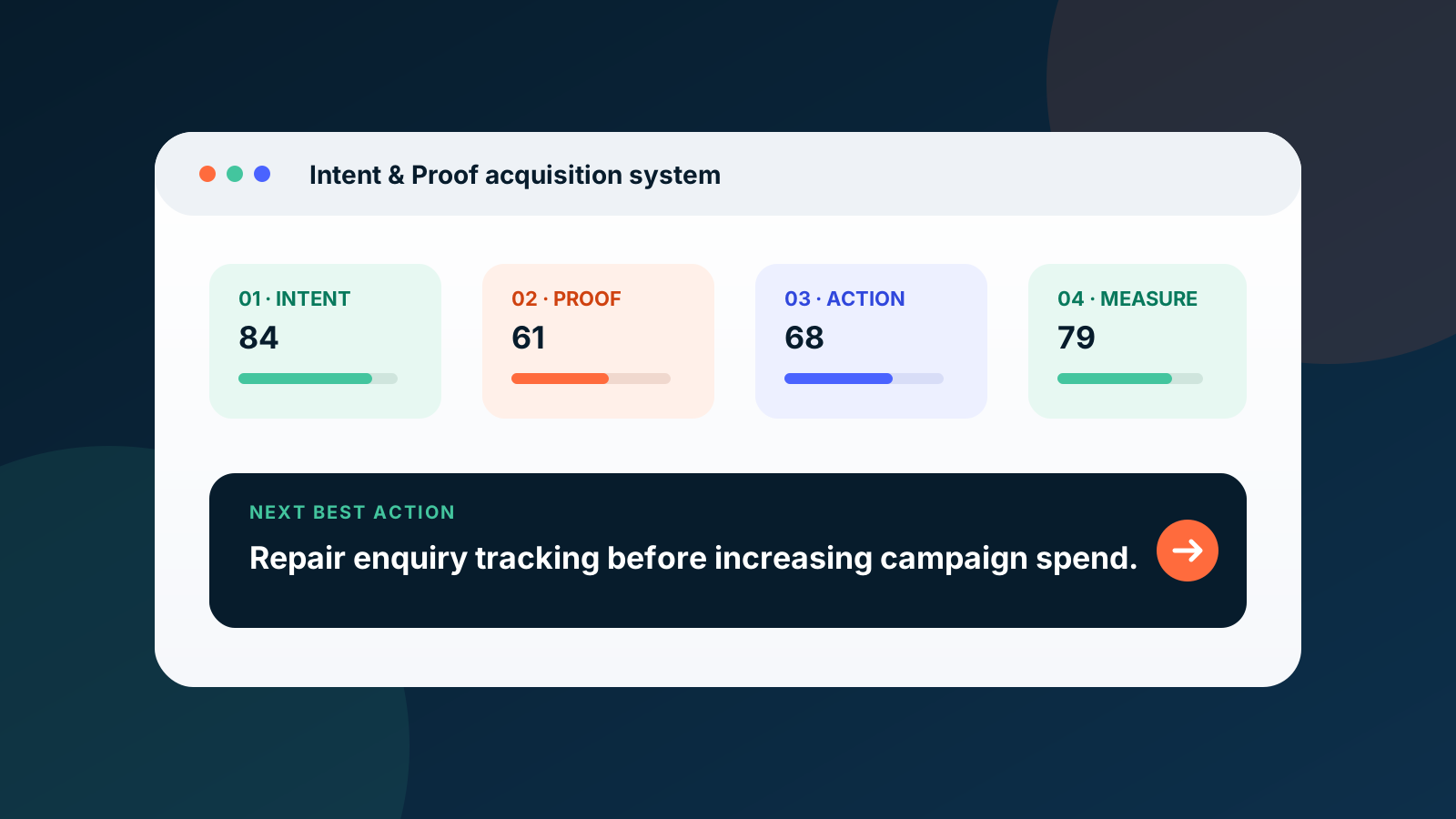
- The Intent & Proof framework connects search intent, evidence, action paths and measurement into one improvement loop.
Local search can make a medical practice visible without making it commercially effective.
A clinic may appear in Google Maps, receive profile views, generate website visits and still struggle to produce a reliable flow of qualified appointments. The reporting looks active. The diary does not. That gap is the real subject of this guide.
Most articles about local SEO for medical practices, SEO for doctors or healthcare local SEO concentrate on visibility: rankings, map placement, citations, reviews and profile completeness. Those elements matter, but they describe only the beginning of the acquisition journey. A practice does not benefit financially when somebody sees a listing. It benefits when the right person understands the offer, trusts the provider, completes an appropriate action and becomes a valuable patient.
The objective is therefore not to manufacture more activity at any price. It is to build a local acquisition system that converts relevant demand into real appointments while preserving clinical authority and brand positioning.
The operating principle: visibility creates an opportunity; intent, proof and a low-friction appointment path convert that opportunity into measurable value.
The problem with vanity metrics in local SEO
Google Business Profile reporting distinguishes between profile views and actions such as calls, website clicks and completed bookings. That distinction matters because the metrics describe different stages of behaviour, not interchangeable forms of success.
A profile view means the practice entered a person’s field of consideration. A website click suggests the person wanted more information. A call or booking action shows stronger intent. An attended, appropriate and commercially valuable appointment is the outcome the practice can actually build around.
The first mistake in many local SEO reports is to collapse these stages into one optimistic narrative. Impressions increase, rankings improve and clicks rise, so the campaign is declared successful. Meanwhile, reception receives the same number of calls, the wrong services attract attention or new enquiries fail to attend.
The local visibility-to-appointment funnel
| Stage | Useful metric | Commercial question |
|---|---|---|
| Search visibility | Relevant local impressions and profile views | Are we appearing for the services and locations that matter? |
| Engagement | Website clicks, calls and booking-link clicks | Does the result create enough relevance and confidence to earn the next action? |
| Enquiry | Calls answered, forms completed and booking starts | Is the action path clear, fast and appropriate to the service? |
| Appointment | Bookings completed and attended | Are enquiries becoming real appointments rather than abandoned or missed contacts? |
| Quality | Qualified appointments and treatment fit | Are we attracting the right cases, not merely more cases? |
| Value | Revenue, contribution margin and patient lifetime value | Is local acquisition improving the economics of the practice? |
A useful local SEO system measures the movement between these stages. A weak one reports the largest number available and hopes nobody asks what happened afterward.
Why more visibility can still produce fewer appointments
More visibility can expose a practice to poorly matched searches. A clinic may rank for a broad treatment term but fail to explain whether it serves the visitor’s specific need. A dental practice may earn clicks for implants while sending every visitor to a generic homepage. A specialist may receive calls from outside the service area because location information is unclear.
This is not a traffic problem. It is an intent alignment problem.
More traffic can also amplify an existing conversion weakness. If the booking page is confusing, doubling visits merely doubles the number of people who encounter the confusion. If proof is generic, more searchers see the same generic claims. If the mobile page is slow, additional demand reaches the same bottleneck.
That is why local search conversion optimization begins with the entire journey, not with another isolated ranking report.
The commercial metrics that matter
A practice should establish a baseline for a small number of connected metrics:
- relevant local search visibility;
- calls, booking actions and qualified forms;
- enquiry-to-booking rate;
- booking-to-attendance rate;
- qualified appointment rate;
- cost per qualified appointment;
- value per qualified appointment;
- revenue or contribution generated by source and service.
The exact benchmark varies by specialty, treatment value, geography and patient journey. Comparing a routine dental hygiene appointment with a complex specialist consultation produces very little insight, despite both being called a conversion by convenient software.
Why Google Business Profile views do not turn into calls or appointments
The long-tail search “Google Business Profile views but no calls” describes a common and useful symptom. It tells us the profile is being encountered, but it does not identify where confidence or action breaks down.
The cause may sit inside the profile:
- the primary category does not represent the priority service;
- services are incomplete or described vaguely;
- opening hours, phone details or location information create uncertainty;
- reviews do not mention the treatment the searcher needs;
- photos fail to communicate the environment, clinicians or level of care;
- the website or booking link sends visitors to an irrelevant destination.
The cause may also sit after the profile. The listing can do its job perfectly and still send the visitor into a weak website, a generic contact page or an appointment system designed by someone with a personal grievance against mobile users.
Google states that local results are mainly influenced by relevance, distance and prominence. Complete information, reviews and links can support local visibility. They do not remove the practice’s responsibility to convert the resulting attention into an appropriate next step.
How to get more patients from Google Maps
The question “how to get more patients from Google Maps” is often answered with a checklist: complete the profile, add photos, request reviews and publish updates. Those actions are useful, but they should be connected to a conversion design.
For each priority service, verify five elements:
- Search match: the category, service and description reflect what the patient is actually searching for.
- Evidence: reviews, images and website content demonstrate relevant experience rather than generic popularity.
- Destination: the preferred link leads to the most appropriate treatment or booking page, not automatically to the homepage.
- Action: calling, requesting information or booking is obvious on mobile.
- Measurement: the practice can distinguish a profile view from a qualified and attended appointment.
Google Business Profile allows eligible businesses to add links that help customers book appointments or review services. The useful question is not whether a link exists. It is whether the link leads to a page that continues the same intent and makes the action feel safe.
Match the profile promise to the landing-page reality
A local result creates an expectation. The website must confirm it immediately.
If the result refers to an emergency dentist in a specific town, the landing page should not begin with the practice’s corporate history. If the query concerns a specialist consultation, the page should establish clinician expertise, process, location, availability and the appropriate route to request an appointment.
The message, proof and action should remain coherent from Google Maps to the final booking confirmation. Every unexplained transition introduces doubt.
The three main leaks in medical practice websites
A medical practice website can be visually respectable and commercially weak. The most common leaks are not mysterious. They are usually visible in the first mobile visit.
Leak 1: unclear or inconvenient appointment paths
Many websites present several competing actions: call, email, fill in a long form, download a brochure, read the news, join a newsletter and inspect every professional association the clinician has encountered since university.
The patient still does not know what to do next.
A strong appointment path answers four questions:
- Is this service appropriate for my need?
- Who will assess or treat me?
- What happens after I make contact?
- What is the easiest appropriate action now?
The primary action should reflect the service. A high-consideration treatment may require a structured enquiry or assessment request. A routine service may support direct booking. An urgent service may prioritise a visible phone route. Treating every visitor with the same generic “Contact us” button discards useful intent.
Leak 2: weak, generic or misplaced proof
“Professional service”, “patient-centred care” and “experienced team” are claims. They may be true, but they do not reduce uncertainty by themselves.
Useful proof is specific to the decision being made. It may include:
- clinician credentials relevant to the treatment;
- experience with a defined patient problem;
- structured case examples where ethically and legally appropriate;
- reviews that mention the service, process or outcome;
- clear explanations of diagnostic and treatment steps;
- recognised technology, methods or professional standards;
- realistic expectations and transparent limitations.
Placement matters. A strong review hidden on a testimonial page does little for a visitor hesitating beside the booking button. Proof should appear near the claim or action it supports.
For local businesses, geographic specificity can strengthen relevance. A review or case example associated with the relevant clinic, service and patient context is more useful than a wall of interchangeable praise collected across unrelated locations.
Leak 3: poor mobile performance and unstable pages
Local healthcare searches frequently occur on mobile devices, often while the user is comparing several providers or trying to act quickly. A heavy page, delayed form, intrusive overlay or shifting button increases friction before the practice has established trust.
Google’s Core Web Vitals describe real-world loading performance, interactivity and visual stability through metrics such as LCP, INP and CLS. These technical indicators are not a substitute for commercial measurement, but they help identify experiences that may obstruct the user.
The practical test is simple: load the priority treatment page on an ordinary mobile connection and attempt to call, request an appointment or complete the form. Do not test only the homepage on office Wi-Fi and declare civilisation complete.
| Leak | Typical symptom | Priority correction | KPI to watch |
|---|---|---|---|
| Booking friction | Visits and clicks rise but enquiries remain flat | Clarify the primary action, shorten forms and align the route with service intent | Visitor-to-enquiry and booking-start rate |
| Weak proof | Visitors consume information but hesitate to act | Add specific credentials, relevant reviews, process evidence and expectations near decisions | Enquiry rate and qualified booking rate |
| Poor mobile experience | Mobile conversion trails desktop or forms are abandoned | Reduce script weight, stabilise layout and test the complete action path | Mobile conversion, completion rate and Core Web Vitals |
How to convert website visitors into patients
The phrase “how to convert website visitors into patients” sounds like a copywriting problem. In practice, it is a system problem.
A visitor becomes a patient only when several operations work together: relevant acquisition, accurate expectations, credible evidence, a usable interface, responsive contact handling and an appropriate clinical fit. Improving the headline while reception misses calls will not solve the system. Neither will buying more traffic for a page that cannot explain the service.
A useful conversion page has three layers.
1. Intent: confirm the visitor is in the right place
The page should state clearly:
- the service or treatment;
- the type of need it addresses;
- the location or coverage area;
- who provides the service;
- the appropriate next step.
Dedicated treatment and service pages usually perform this task better than a homepage attempting to represent every possible patient and procedure at once.
For multi-location clinics, the architecture should also make location relevance explicit without producing dozens of near-duplicate pages. Each location page should contain genuine operational differences: clinicians, services, access information, contact routes, local evidence and availability.
2. Proof: reduce risk with evidence
Healthcare decisions involve perceived risk, trust and often uncertainty. The page must show why the practice is a credible choice for this specific need.
Proof should answer the visitor’s likely objections:
- Does this clinician handle cases like mine?
- What happens during the first appointment?
- Is the process appropriate, safe and transparent?
- What evidence supports the practice’s claims?
- What do relevant patients say about the experience?
- What happens if I am not suitable for the treatment?
The strongest proof is rarely the loudest. It is the evidence most closely aligned with the visitor’s decision.
3. Action: make the next step proportionate and clear
The action should not demand more commitment than the visitor is ready to make.
For a complex or expensive treatment, “Book treatment now” may be premature. “Request an assessment” may better reflect the real clinical and commercial process. For routine services, direct booking can be appropriate. For urgent care, phone access and response expectations may matter most.
Provide one obvious primary action and limited secondary alternatives. Explain what happens next. Confirm response times where the practice can reliably meet them.
Healthcare landing page optimization for local search intent
Healthcare landing page optimization should begin with the query and end with a measured appointment outcome.
A useful landing-page review asks:
- What exact problem, treatment or location brought the visitor here?
- Does the first screen confirm that match?
- Is the relevant clinician or practice authority visible?
- Is evidence specific enough to reduce risk?
- Is the action clear on mobile?
- Can we track the path to a qualified and attended appointment?
The landing page should not imitate a discount flyer merely because paid traffic is involved. Premium positioning can remain calm, factual and evidence-led. Clear value, expertise, process and patient fit often reduce price sensitivity more effectively than decorative urgency or permanent “limited-time” offers that have somehow survived several geological eras.
The Intent & Proof system applied to local markets
The Intent & Proof system treats local acquisition as four connected disciplines.
Intent alignment
Intent alignment ensures that the search term, local result, page and appointment route describe the same need.
For each commercially important service, map:
- the patient’s likely query;
- the relevant location;
- the correct profile category or service;
- the best landing page;
- the appropriate action;
- the value and qualification criteria for the resulting appointment.
This prevents broad traffic growth from masking weak commercial relevance.
Proof architecture
Proof architecture organises evidence around decisions rather than storing all credibility on one testimonial page.
A practice can build proof at several levels:
- practice proof: reputation, standards, facilities and operating history;
- clinician proof: qualifications, expertise and relevant experience;
- service proof: process, technology, case relevance and expectations;
- local proof: reviews, cases and operational evidence tied to the location;
- outcome proof: measurable or observable results where claims remain compliant and responsible.
The objective is not to make the website boast more aggressively. It is to make the visitor work less hard to verify the claims.
Appointment-path design
The website, profile and internal contact process should behave as one system.
A booking button is not the end of the path. The practice should verify:
- whether the booking system works well on mobile;
- whether the selected appointment type is clear;
- whether forms request only necessary information;
- whether confirmation messages set expectations;
- whether calls are answered or returned promptly;
- whether source information survives into the practice’s reporting.
A technically successful form submission that disappears into an unmanaged inbox is not a conversion. It is an electronic method for disappointing two people at once.
Measurement integrity
Measurement should connect acquisition signals to commercial quality.
The minimum viable chain is:
source → landing page → enquiry → booking → attendance → qualified appointment → value
Not every practice will have a sophisticated CRM. A disciplined spreadsheet or practice-management export can still provide a useful starting point if source, service, status and value are recorded consistently.
The purpose is to identify which actions improve the quality of demand. That creates a continuous loop:
measure → diagnose → improve → verify → retain what works
How to evaluate medical SEO services by appointment quality
The commercial query “medical SEO services” reflects a buyer who is closer to selecting help. The evaluation standard should therefore be more demanding than a list of promised rankings.
A credible medical SEO service should be able to explain:
- which services and locations are economically important;
- how search demand will be segmented by intent;
- how Google Business Profile work connects to landing pages;
- how treatment, clinician and location pages will avoid duplication;
- how proof will be collected and positioned;
- how calls, forms, bookings and qualified appointments will be tracked;
- how technical performance will be monitored;
- how success will be assessed beyond traffic.
Ask for reporting that connects visibility to action and action to quality. Rankings are diagnostic inputs. They are not payroll.
SEO for doctors should preserve authority
SEO for doctors and clinics should not force the practice into exaggerated claims, generic urgency or price-led positioning. Search optimisation can remain compatible with professional authority when content is accurate, useful, specific and evidence-led.
The practice should be easier to understand, not louder. It should make expertise visible, explain the patient journey and remove unnecessary friction. The same principle applies to dentists, specialist clinics and other local professionals whose services depend on trust.
A 30-day plan to increase patient appointments
The first month should focus on diagnosis and high-leverage corrections, not a ceremonial publication schedule.
| Period | Work | Deliverable | Decision metric |
|---|---|---|---|
| Days 1–5 | Establish baseline across profile, website, calls, bookings and appointment quality | Visibility-to-appointment funnel with current conversion rates | Clear location of the largest measurable drop |
| Days 6–10 | Review priority queries, services, categories and landing destinations | Intent map for the highest-value services and locations | Percentage of priority demand with a matched page and action |
| Days 11–17 | Improve one priority treatment or service page | Stronger first screen, proof placement and appointment route | Change in qualified enquiry and booking-start rate |
| Days 18–23 | Correct profile links, services, evidence and local consistency | Profile-to-page alignment for priority services | Calls, website actions and relevant bookings |
| Days 24–27 | Test mobile speed, forms, calls and confirmations | Friction log and corrected action path | Mobile completion and contact success rate |
| Days 28–30 | Compare results and define the next experiment | One-page decision report | Improvement against baseline and confidence in the data |
This plan deliberately improves one important path before expanding into dozens of pages. The practice learns more from a measured correction than from publishing ten unmeasured articles about broadly related health topics.
The KPI set for a local medical acquisition system
A simple dashboard should show only metrics capable of changing a decision.
| KPI | Definition | What it reveals |
|---|---|---|
| Relevant local visibility | Impressions or profile exposure for priority services and locations | Whether the practice is present for valuable demand |
| Profile action rate | Calls, website clicks and booking actions divided by relevant profile exposure | Whether the local result earns a next step |
| Landing-page enquiry rate | Qualified calls or forms divided by relevant landing-page sessions | Whether intent, proof and action work together |
| Enquiry-to-booking rate | Completed bookings divided by qualified enquiries | Whether the booking process and contact handling work |
| Attendance rate | Attended appointments divided by completed bookings | Whether expectations and reminders support real attendance |
| Qualified appointment rate | Suitable appointments divided by attended appointments | Whether acquisition attracts the right patient need |
| Cost per qualified appointment | Acquisition cost divided by qualified appointments | Whether growth is economically efficient |
| Appointment value | Revenue or contribution associated with qualified appointments | Whether the channel produces meaningful value |
The practice can add detail when a decision requires it. It should not begin with an aircraft cockpit of charts that nobody can connect to an operational action.
Build a quality loop, not a one-time optimisation project
Local acquisition changes over time. Competitors improve, search behaviour shifts, clinicians join or leave, services change and reviews accumulate. The system needs a repeated quality loop.
For every significant action, record:
- the baseline;
- the change made;
- the expected mechanism;
- the KPI that should respond;
- the observation period;
- the actual result;
- the decision to retain, revise or remove the change.
This creates institutional learning. The practice stops asking whether “SEO works” as one indivisible activity and begins identifying which combinations of intent, proof, page design and contact process improve qualified appointment value.
The same loop helps an external partner improve performance. It replaces monthly activity lists with a sequence of measured decisions.
Final principle: do not discount a system problem
When local visibility fails to produce appointments, reducing price can appear to be the fastest response. It may also hide the actual leak.
The patient may not understand the service. The website may not demonstrate enough relevant proof. The booking route may be inconvenient. Calls may go unanswered. The landing page may load poorly on mobile. Tracking may count every form equally while ignoring whether the resulting appointment was appropriate or valuable.
Discounting does not repair those failures. It merely changes the audience’s reason for tolerating them.
A stronger strategy is to improve the quality of the acquisition journey:
- attract relevant local intent;
- confirm the service and location immediately;
- provide specific, credible proof;
- make the appropriate action easy;
- measure through to appointment quality and value;
- repeat the cycle using what the data actually shows.
That is how local SEO for medical practices becomes a commercial system rather than a visibility report.
Sources and methodology
This guide uses a conversion-focused operating model and current first-party documentation from Google:
- Google Business Profile performance and available interaction metrics
- Google guidance on relevance, distance and prominence in local ranking
- Google Business Profile appointment and service links
- Google Search Central guidance on Core Web Vitals
- Google Search Central guidance on LocalBusiness structured data
Search-demand research for this article covers the semantic cluster around SEO for doctors, medical SEO services, healthcare local SEO and how to get more patients from Google Maps. The article uses those topics where they clarify the reader’s problem rather than repeating exact phrases as decoration.
Frequently asked questions
Why does my Google Business Profile get views but no calls?
Profile views show that people encountered the listing, not that the listing created enough relevance, confidence or urgency to act. Common causes include an unclear service match, weak reviews for the specific treatment being searched, incomplete profile information, a generic website link, no direct booking route, inconsistent phone handling and a mobile page that loads slowly or makes the next step difficult. Compare views with calls, website clicks, booking actions and completed appointments to locate the actual leak.
How can a medical practice get more patients from Google Maps?
Start by matching the Business Profile to real patient intent: accurate categories, complete services, current hours, relevant photos, a strong review process and a preferred booking or service link. Then send each important query to a page that explains the treatment, location, clinician, evidence and next step. The objective is not simply more Maps visibility. It is a higher percentage of qualified searchers becoming booked and attended appointments.
What is a good medical website conversion rate?
There is no universal rate that is meaningful across every specialty, location, traffic source and appointment value. A cosmetic dentistry landing page, a physiotherapy practice and a specialist clinic have different intent and economics. Measure at least visitor-to-enquiry rate, enquiry-to-booking rate, booking-to-attendance rate and qualified appointment value. Your useful benchmark is the practice's own baseline, segmented by source, service, device and landing page, followed by controlled improvement over time.
How do you convert website visitors into patients?
Conversion requires three things in sequence: a clear match between the visitor's need and the page, credible proof that reduces perceived risk, and an easy action path. Use dedicated treatment and location pages, specific clinician credentials, relevant patient evidence, clear expectations, visible contact options and short forms. Track the entire path through to attended and qualified appointments so that changes are judged by commercial quality rather than form submissions alone.
Does website speed affect patient appointment bookings?
Speed is not the only factor, but a slow or unstable mobile experience adds friction at the exact moment a patient is comparing options or trying to book. Large images, excessive scripts, delayed buttons and layout shifts can make information harder to access and actions easier to abandon. Test the actual treatment and booking pages on mobile, then compare performance improvements with booking and completion rates rather than treating a technical score as the final business result.
Why is my dental website not generating patients?
A dental website can look professional and still fail commercially when its pages are generic, proof is vague, treatment information is difficult to find, calls to action are inconsistent or tracking stops at the first form submission. Review the journey for each priority treatment: search query, Google result, landing page, evidence, booking action, contact handling and attended appointment. The weakest stage usually explains more than the site's visual design.
Should a clinic use discounts to increase appointment bookings?
Discounts can increase response in some situations, but they can also attract price-sensitive enquiries, weaken premium positioning and obscure the real conversion problem. Before reducing price, improve service clarity, proof, convenience, response time and the booking path. A strong local acquisition system should help the right patient understand value before price becomes the only available basis for comparison.