Summary
Key takeaways
- A contact is not a patient: practices need to measure enquiries, reached contacts, booked appointments, attended first visits and demand quality.
- Reducing price-only comparisons requires specific treatment pages, verifiable proof and a first-visit journey that patients can understand.
- Dental SEO should be organised around treatment, problem, location and decision stage rather than a collection of generic pages.
- The front desk and practice-management system are part of acquisition because they determine how many enquiries become attended appointments.
- Clinical data should remain separate from the information needed to measure marketing performance.
- Future visibility will also depend on publishing clear, verifiable content that search and answer engines can cite accurately.
Dental marketing should not be judged by the number of clicks, forms or telephone calls it produces. For the owner or director of a dental practice, the more useful question is how many people with a relevant need are informed properly, handled by the front desk and guided towards an attended first visit.
That distinction changes how a practice evaluates its website, local SEO, Google Ads and external suppliers. Forty enquiries may look impressive in a report. If only ten people are reached, four book and two attend, the original number describes volume rather than effectiveness.
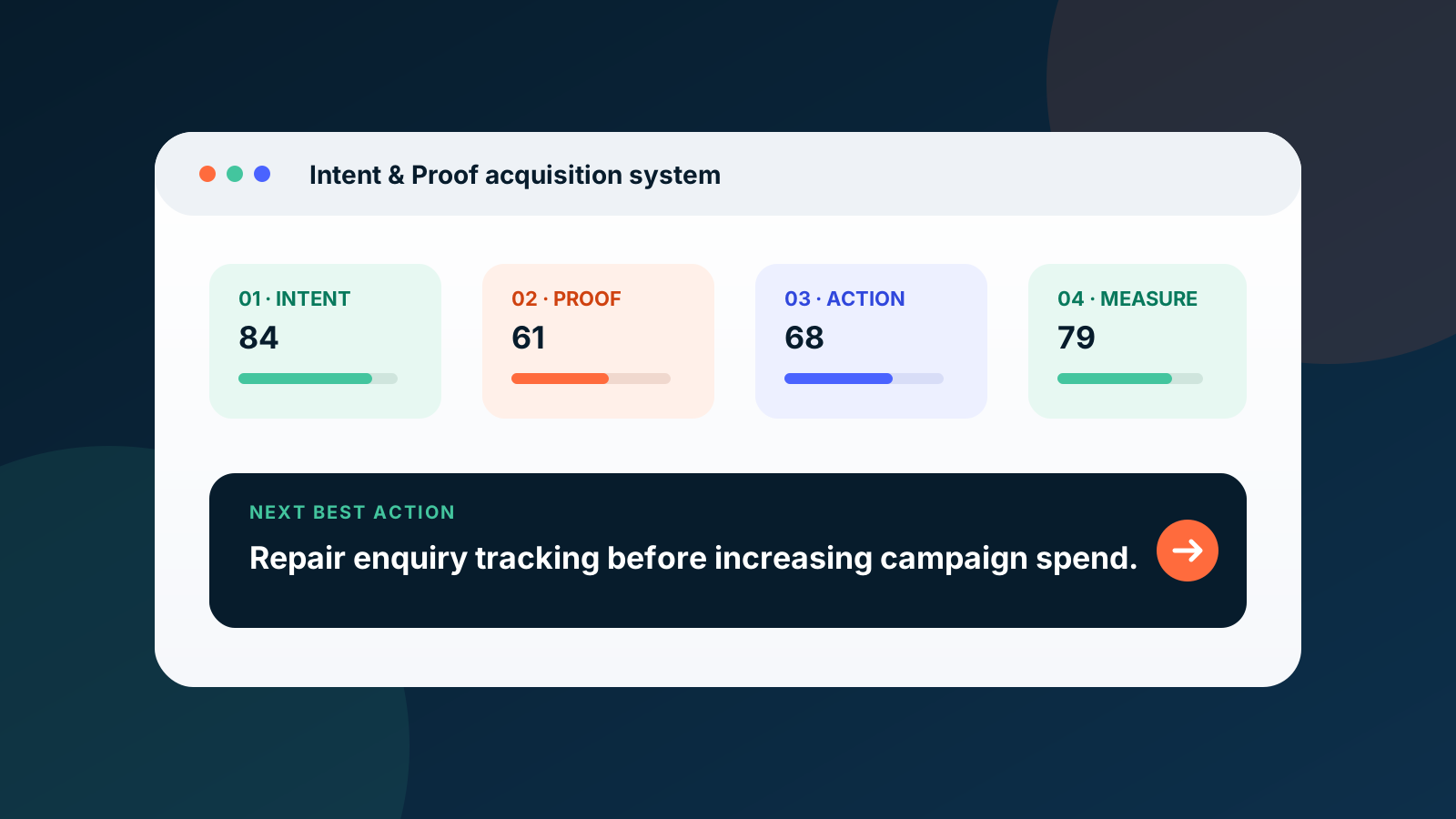
A dental acquisition system connects search demand, page, enquiry, front-desk handling, appointment and attended first visit without confusing marketing with clinical assessment.
This guide is for practice owners, partners, clinical directors and managers who want to understand where opportunities are being lost and which parts of the system need to work together. The objective is not to turn a healthcare practice into a call centre. It is to make the path between an online search and an appropriate first visit more understandable, measurable and reliable.
The problem dental marketing must actually solve
A practice does not invest in SEO, advertising or automation simply to own more digital tools. It invests to reduce recognisable operational problems:
- excessive dependence on word of mouth;
- an uneven diary for priority treatments;
- difficulty making specialist services visible;
- enquiries from outside the real catchment area;
- conversations focused exclusively on price;
- appointments booked but not attended;
- no reliable connection between marketing spend and first visits.
Problems begin when each symptom is assigned to a separate activity. The website counts forms, Google Ads counts conversions, the front desk handles calls and the practice-management system records appointments and treatment plans. The information exists, but each system uses a different definition of success.
The journey that matters is one continuous sequence:
search → page → enquiry → contact handled → appointment booked → first visit attended
After the first visit, clinical responsibility begins. Marketing cannot determine diagnosis, suitability or treatment. It can preserve the context of the enquiry, measure the transitions and show where the journey breaks down.
| Observed problem | Possible cause | What the practice should verify |
|---|---|---|
| Too few relevant enquiries | Pages and campaigns are too broad | Search term, location and treatment intent |
| Too many price-only conversations | Process and differences are unclear | Content, proof and value of the first visit |
| Many contacts, few appointments | Weak handling or poorly matched demand | Response time and recorded call outcomes |
| Many bookings, low attendance | Expectations, delay or confirmation problems | No-shows by source, treatment and location |
| Spend cannot be attributed | Reporting stops at the form | Connection between source and attended visit |
The first correction is therefore not choosing another channel. It is defining what the practice considers a useful result and ensuring that the website, front desk and management system recognise that result in the same way.
A contact, an appointment and a patient are not the same thing
The word lead is convenient for campaign reporting but too imprecise for managing a dental practice. It describes an expression of interest, not an outcome.
| Stage | Operational meaning |
|---|---|
| Visit or click | A person reaches the website or profile |
| Enquiry | They submit a form, message or telephone call |
| Contact handled | The practice responds and records the outcome |
| Appointment booked | A first visit is agreed |
| First visit attended | The person arrives |
| Clinical assessment | A clinician evaluates the case |
| Plan or recommendation | The practice presents an appropriate next step |
Confusing these stages creates predictable arguments. The agency says it generated leads; the practice says the leads were poor. Both statements may be true. Without knowing how many people were reached, which requests were relevant and how many visits were attended, nobody can diagnose the problem.
The qualified first visit as a commercial measure
For marketing purposes, a first visit can be described as qualified when the enquiry matches a service the practice genuinely provides, the territory it serves and the type of appointment it offers. The term does not indicate clinical suitability, which can be assessed only by the clinician.
Cost per qualified first visit = cost attributed to the source ÷ relevant attended first visits
The measure is useful because it prevents a campaign from being rewarded for producing cheap but unreachable forms. It should be reviewed alongside contact rate, booking rate, attendance rate and the reasons enquiries are lost.
For the calculation to mean anything, the practice must record at least:
- where the enquiry came from;
- whether contact was attempted;
- whether the person was reached;
- whether an appointment was booked;
- whether the appointment was attended;
- whether the request matched the service and territory.
A missing stage turns the result back into an estimate.
Why prospective patients compare only on price
The problem is not that a person asks about cost. Dental treatment can represent a substantial financial decision, and the question is legitimate.
The problem begins when the practice gives the prospective patient no better criteria for choosing.
If two websites use the same stock photographs, repeat the same claims about excellence and end with the same vague “Contact us” button, the reader can compare only what is visible: location, availability and price. The patient is not behaving irrationally. The communication has failed to make any meaningful difference understandable.
Price becomes dominant when expertise, assessment, materials, alternatives, limitations, aftercare and the value of the first visit remain vague.
This is especially important for implant dentistry, complex rehabilitation, clear aligners and cosmetic procedures. Cost-related searches often express uncertainty rather than a desire for the cheapest provider. A page that answers only “book a consultation for a quotation” transfers that uncertainty to the front desk, where the first conversation begins as a negotiation.
How marketing creates price-led demand
Campaigns tend to attract price-only comparisons when they use:
- broad keywords with little treatment or location precision;
- advertisements dominated by discounts, instalments or urgency;
- landing pages that imply a solution before assessment;
- generic claims about technology or materials;
- forms that collect only a name and telephone number;
- no explanation of what the first visit includes.
Supplier incentives can worsen the problem. An agency rewarded only for lead volume is encouraged to widen targeting and reduce form friction. Cost per lead falls while the quality of demand may deteriorate. The system produces exactly what it was asked to produce, just not what the practice needed.
Price-related searches should not be excluded automatically. “How much does a dental implant cost?” may come from a serious prospective patient beginning their research. A responsible answer explains the factors that influence cost, why assessment is required and which questions cannot be answered reliably online.
Give patients better criteria for choosing
Reducing price-only comparison requires five connected improvements.
1. Capture more precise demand.
“Cheap dental implant” expresses a different intention from “implant dentist near me”, “same-day implant assessment” or “fixed teeth with bone loss”. Campaigns and content should distinguish those searches rather than send them all to one page.
2. Explain the assessment.
Timing, indication, materials, complexity and cost depend on the individual situation. Explaining that clearly is not an excuse to avoid price. It is an accurate description of how responsible treatment planning works.
3. Show relevant proof.
Clinician qualifications should relate to the treatment. Technology should be genuinely used. Reviews should help readers understand clarity, organisation and care. Cases, where publication is appropriate, should include context and limitations rather than functioning as spectacle.
4. Make the first visit understandable.
The website should explain who the patient will meet, what may be assessed, what information may be useful and what happens afterwards. The first visit then becomes a valuable clinical step rather than an administrative barrier before receiving a figure.
5. Record why enquiries are lost.
“Good lead” and “bad lead” are not useful categories. Better outcomes include unreachable, outside area, irrelevant request, price-only enquiry, appointment booked, cancelled, no-show and attended visit.
After several weeks, those reasons reveal whether the next correction belongs in keyword targeting, page content, availability, front-desk handling or appointment confirmation.
SEO for dentists starts with a demand map
Dental SEO should not begin with a spreadsheet of keywords sorted only by search volume. It should connect the way prospective patients describe a need with the treatments and locations the practice genuinely provides.
A useful demand map considers four dimensions:
Treatment × patient problem × location × decision stage
Technology and brand searches can be added where they are relevant and genuinely supported.
| Dimension | Examples | Purpose |
|---|---|---|
| Treatment | implants, clear aligners, veneers, hygiene | Identifies the service area |
| Problem | missing teeth, bone loss, crooked teeth, urgent pain | Reflects patient language |
| Location | city, neighbourhood, county, “near me” | Connects demand to the real catchment |
| Decision stage | information, comparison, assessment, urgency | Determines page type and next action |
This structure avoids two opposite mistakes. One is building a site with only broad service pages. The other is creating hundreds of near-identical URLs by combining every treatment with every town and question. The first is too vague; the second produces thin pages that are difficult to maintain and support with real evidence.
The principal search families
Broad local searches include “dentist near me”, “dental practice + city”, “dentist open Saturday” and emergency queries. They require accurate local information, a strong Google Business Profile and pages that make contact straightforward.
Treatment searches include implant dentistry, clear aligners, veneers, whitening and periodontics. The page should confirm that the practice genuinely provides the service and identify who is responsible for assessment.
Problem-based searches use patient language such as “bleeding gums”, “broken tooth”, “fixed teeth with bone loss” or “crooked teeth options”. Many deserve educational content rather than an immediate sales page.
Cost and comparison searches include “implant cost”, “Invisalign price”, “All-on-4 alternatives” and “veneers reviews”. They should be addressed transparently without presenting a universal figure or implying suitability before assessment.
Technology or brand searches can indicate greater awareness. A page is justified only when the practice genuinely uses the system and can explain its place within diagnosis, planning and maintenance.
From keyword list to page decision
For each important search theme, the practice should answer:
| Field | Decision |
|---|---|
| Intent | What is the person trying to understand or do? |
| Service | Which real service can answer that need? |
| Destination | Which page is the most coherent next step? |
| Proof | What must be demonstrated? |
| Action | Read, call, message or request an appointment? |
| Priority | How valuable is the demand to the practice? |
| Risk | Are there clinical, regulatory or privacy constraints? |
A practice does not need to publish everything at once. It can begin with three or four high-priority treatment journeys, build them properly and expand after observing real behaviour.
Website architecture for dental SEO
Ranking one isolated page is not the objective. The practice needs a structure in which search engines, prospective patients and answer engines can understand:
- who the practice is;
- where it operates;
- which treatments it provides;
- which clinicians deliver them;
- what happens during the first visit;
- which page answers each patient need.
A practical initial architecture can include:
- an authoritative homepage;
- a page for each real location;
- a page for each priority treatment;
- complete clinician profiles;
- a clear first-visit page;
- educational content for patient questions;
- operational information about access, hours and urgent care;
- an editorial archive with authors, sources and update dates.
The homepage should not attempt to answer every treatment in equal depth. That approach usually produces a wall of icons and short paragraphs that mention everything while explaining nothing.
Treatment pages should follow the patient’s decision
A strong treatment page should usually address:
| Section | Purpose |
|---|---|
| Opening | Confirm treatment, location and type of assessment |
| Direct answer | Explain the service in accessible language |
| Clinician | Make responsibility and expertise verifiable |
| Assessment | Clarify why individual evaluation is necessary |
| Process | Describe the likely stages without promising outcomes |
| Technology and materials | State only what is genuinely used |
| Benefits and limitations | Support an informed decision |
| Alternatives | Avoid presenting one solution as inevitable |
| Cost factors | Explain what shapes the plan |
| Proof | Add relevant reviews, method and appropriate cases |
| Next step | Request an assessment or contact the practice |
A treatment page is not a brochure. It should help a prospective patient ask better questions and understand why the next responsible step is an assessment.
Internal links should follow the patient journey
An article about bleeding gums can link to the periodontics page, the relevant clinician and the first-visit process. A treatment page can link to specific questions, the location where the service is available and practical appointment information.
This network helps readers move through the decision and helps automated systems understand the relationship between treatments, clinicians and locations.
Link text should describe the destination naturally. “What happens during an implant assessment” is more useful than “click here” and more readable than repetitive keyword stuffing.
Local pages must represent real locations
A local page is useful when it contains genuine operational information: clinicians, treatments, opening hours, access, parking, telephone details and availability at that location.
A single-location practice should not create artificial clinic pages for dozens of towns. Near-identical pages with only the city name replaced provide little value and create maintenance risk.
Technical foundations still matter
Content quality does not compensate for a site that blocks indexing, loads slowly or creates inconsistent URLs. The essentials include:
- correct canonical URLs;
- an updated XML sitemap;
- HTTPS;
- usable mobile navigation;
- accessible forms and buttons;
- optimised images;
- structured data that matches visible content;
- monitoring for broken pages and redirects.
The most useful test remains practical: open a priority treatment page on an ordinary smartphone, find the relevant answer, verify the clinician and attempt to request a visit.
Google states that its local results are based mainly on relevance, distance and prominence. Distance cannot be engineered away. Relevance and prominence can be improved through accurate business information, appropriate pages, reviews and authority. Source: Google Business Profile
Local SEO and Google Business Profile
For many dental searches, the first meaningful page is the local result rather than the practice homepage. The prospective patient sees the name, rating, distance, photographs, opening hours and contact options before reaching the website.
The Google Business Profile is therefore one of the main entrances into the system.
Accuracy before optimisation
The profile name should match the real practice identity rather than include artificial treatment or city keywords. Categories should reflect actual services. Hours, special opening times, address, telephone number and appointment links should remain current.
The profile should promise only what the website can confirm. If it lists implant dentistry, clear aligners and urgent care, the website should contain pages that explain those services. If a location does not provide a treatment, it should not inherit that claim from group-wide copy.
Reviews as local proof
Reviews influence decisions and can contribute to local prominence. A responsible review process:
- invites genuine patients without incentives;
- does not dictate keywords or sentiment;
- does not ask people to reveal treatment details;
- avoids confirming publicly that a reviewer is a patient;
- responds without disclosing health information.
A useful review often describes clarity, organisation, welcome, punctuality and the journey through the practice. A large collection of indistinguishable “excellent service” comments provides less reassurance than a smaller set of specific, authentic experiences.
Photography should reduce uncertainty
Real photographs of the entrance, reception, treatment environment and team help a prospective patient recognise the practice. Stock imagery may support design but cannot establish local identity.
Clinical images and cases require a different standard. Removing a name or obscuring part of a face does not automatically make a person anonymous. Publication should be based on the rules, permissions and professional responsibilities that apply in the relevant jurisdiction.
Measure actions beyond profile views
Profile views and interactions are useful, but they do not show whether first visits occurred. The practice should distinguish:
- telephone calls;
- website visits;
- direction requests;
- bookings;
- attended appointments.
A rise in views is valuable only when it concerns the correct services and catchment area.
Trustworthy dental content and clinical responsibility
Dental content can influence health decisions and financial expectations. Reliability should therefore be designed into the publishing process rather than asserted with phrases such as “trusted experts”.
Identify authors and reviewers
Important content should show:
- who wrote it;
- who reviewed clinical claims where appropriate;
- the person’s relevant role and credentials;
- when the page was genuinely updated.
A clinical reviewer should do more than lend a name to the footer. They should be able to check accuracy, limitations and the relationship between the content and the services actually provided.
Automatically changing the date without reviewing the page weakens rather than improves credibility.
Use the right source for the claim
Clinical claims should rely on suitable scientific, professional or institutional sources. Operational claims should come from the practice. Google policies should be cited from Google. Legal requirements should be linked to official or authoritative sources for the relevant market.
Not every sentence needs a citation. Claims that affect treatment expectations, risk, regulation or data handling need stronger support than general advice about page layout.
Make clinical limits visible
Content can explain treatments, common questions, likely assessment stages and factors that influence cost. It should not diagnose an individual reader or promise a result.
Useful wording separates what can be explained generally from what must be determined during assessment. That protects clinical responsibility and makes the page more trustworthy.
Structured data clarifies; it does not create authority
Structured data can help search engines understand articles, organisations, clinicians, breadcrumbs and other supported entities. It should match visible information and should never invent locations, qualifications, reviews or procedures.
Google states that AI Overviews and AI Mode do not require special AI markup beyond established SEO practices. Structured data reduces ambiguity; it does not purchase inclusion or citation. Source: Google Search Central
Dental SEO in the age of AI-generated answers
Search is no longer limited to a short query followed by ten links. People increasingly ask detailed questions, request comparisons and refine them conversationally.
For dental practices, this creates both risk and opportunity. A system may summarise treatment options without sending the reader to the practice. It may also cite a practice page for a specific, local or specialist question that traditional keyword research would have treated as too small.
Build for questions, not only keywords
A person may begin with “dental implant cost” and then ask:
- what affects the price;
- which investigations may be needed;
- whether bone loss changes the options;
- how immediate loading differs from a conventional route;
- what alternatives may exist;
- what happens during the first visit;
- how to compare practices locally.
One page may answer several of these questions, while others require connected articles or clinician pages. The objective is a coherent body of information, not a separate FAQ page for every possible phrase.
Make important answers easy to extract accurately
A section should often begin with a direct answer and continue with conditions, exceptions and explanation.
For example:
Local SEO for dentists is the process of aligning a practice’s website, treatment pages, clinicians, locations, Google Business Profile, reviews and technical information so that relevant local searches lead to an appropriate page and next step.
The statement is understandable on its own. The surrounding text can then explain implementation and limitations.
Tables, clear headings and original operating models can improve citation readiness because they reduce ambiguity. Their value lies in clarity and genuine contribution, not in performing rituals for an algorithm.
Keep entities consistent
The practice name, address, clinicians, locations and services should be consistent across the website, Google Business Profile and trustworthy external sources.
A clinician mentioned without a profile, role or verifiable connection to the location is harder to understand. A treatment attributed vaguely to “our team” provides less context than a page that identifies responsibility accurately.
ChatGPT Search and Bing citation reporting
OpenAI states that public websites may appear in ChatGPT search and that publishers should not block OAI-SearchBot if they want content to be included in summaries and snippets. OpenAI also adds utm_source=chatgpt.com to referral links, allowing those visits to be identified in analytics. Source: OpenAI Publishers and Developers FAQ
Allowing a crawler does not guarantee a citation. The content still needs to be public, indexable, useful and understandable.
Bing Webmaster Tools introduced AI Performance reporting in 2026, including citations, cited pages and grounding-query information across supported Microsoft AI experiences. That makes generative visibility more observable, although citation count alone does not measure commercial value. Source: Bing Webmaster Blog
A dental practice should connect AI visibility with:
- the page and treatment cited;
- the territory served;
- referral traffic where identifiable;
- enquiries;
- attended first visits.
A national informational citation may be useful for authority while producing little local demand. Context still matters.
Google Ads for dentists
Google Ads can capture people already searching for a treatment or local provider. That makes search advertising useful for expressed demand, but it does not remove the need for precision.
A campaign built broadly around “dentist”, “implants” and “clear braces” may produce clicks while generating little relevant demand. Performance depends on the relationship between search term, advertisement, page, location, availability and front-desk handling.
Structure campaigns around treatment and intent
A sensible account separates:
- the practice’s own brand;
- broad local demand;
- priority treatments;
- urgent care;
- cost and comparison searches where appropriate.
Implant dentistry, clear aligners and cosmetic dentistry should not share one ad group and one generic landing page.
Separation allows the practice to control:
- advertisement message;
- keywords and match types;
- negative keywords;
- location and scheduling;
- destination page;
- primary call to action;
- performance by treatment.
Negative keywords should not be applied mechanically. Excluding every query containing “cost” may remove serious prospective patients. Leaving terms such as “free”, “cheap” and irrelevant educational searches uncontrolled can waste budget. Real search terms should be reviewed in context.
Continue the promise on the landing page
If an advertisement concerns an implant assessment, the landing page should explain that assessment and identify the relevant clinician and location. Sending the user to a generic homepage forces them to restart the search inside the website.
The page should continue the question and clarify the next step.
Cost per lead is not enough
Reporting should connect:
spend → enquiries → reached contacts → bookings → attended first visits
Cost per lead remains useful as a technical metric. It should not be the final commercial measure.
A campaign with expensive enquiries may produce many attended visits. A campaign with cheap forms may produce mostly unreachable or irrelevant contacts. The practice needs the later stages before reallocating budget.
Healthcare advertising restrictions
Healthcare advertising and personalised targeting rules differ by market and platform. Google classifies health-related content as a sensitive interest area and restricts targeting based on personal health conditions. A feature appearing in the advertising interface does not mean it is suitable for every dental campaign. Source: Google Ads policy
Practices should be particularly cautious with:
- remarketing based on visits to treatment or condition pages;
- customer lists derived from healthcare enquiries;
- audience names that reveal treatment interest;
- conversion events containing health-related detail;
- imported strategies copied from ordinary retail accounts.
Policy review should be part of campaign maintenance, not a one-off check before launch.
Dental landing pages that support an appropriate first visit
A landing page is where the promise of the search result or advertisement is tested. It should reduce three uncertainties:
- Am I in the right place?
- Can I trust this practice?
- What happens if I make contact?
A prominent button cannot compensate for vague answers.
Opening and message match
The first screen should identify the treatment, location and type of assessment clearly. It does not need to contain every detail, but the visitor should recognise immediately that the page matches the search.
“Rediscover the smile you deserve” may sound emotional, but it does not explain whether the page concerns implants, orthodontics or whitening. A more informative headline qualifies the visit and reduces dependence on slogans.
The call to action should describe the real next step:
- Request an assessment
- Book a first visit
- Speak to the front desk
“Book the treatment” may be premature. “Learn more” may be too vague.
Place proof where doubt appears
Clinician information should appear when the treatment is introduced. Location photography should support practical information. Relevant reviews should appear near the first-visit decision. Sources should sit near claims that require verification.
A block of awards and logos without explanation may look impressive while answering none of the patient’s concerns.
Explain cost without producing false certainty
Where the practice can state a reliable range or included elements, the information should be accurate, current and appropriate for the market. Where it cannot, the page should explain which factors shape the plan.
Financial information may include:
- assessment requirements;
- diagnostic investigations;
- treatment complexity;
- materials and laboratory work;
- number and location of teeth;
- staged or alternative options;
- payment arrangements where applicable.
Finance can be useful, but it should not replace clinical appropriateness or become the only point of differentiation.
Contact forms should collect only what is needed
Shorter forms do not automatically produce better outcomes. A form with only name and telephone number may increase submissions while leaving the front desk with no context.
A first-contact form may reasonably ask for:
- name;
- contact route;
- preferred location;
- preferred time;
- broad area of interest;
- contact preference;
- required notices or choices.
It should not request detailed medical history, radiographs, photographs or diagnosis through a generic marketing system. Secure clinical document routes should remain separate.
Chatbots and messaging need a process
A chatbot can answer operational questions, collect preferences and transfer the enquiry. It should not diagnose, promise suitability or simulate a clinician.
WhatsApp or other messaging can reduce friction, but the practice still needs to decide:
- who responds;
- during which hours;
- how quickly;
- how the outcome is recorded;
- how relevant information reaches the authorised system.
A messaging button without a process can create many conversations and very little usable knowledge.
Mobile and accessibility
Most local searches and actions occur on smartphones. Priority pages should have:
- readable text;
- adequate contrast;
- labelled form fields;
- reachable buttons;
- clickable telephone numbers;
- stable layouts;
- sensible loading time;
- keyboard and assistive-technology support.
Accessibility helps people use the site and helps automated systems interpret its structure. OpenAI’s publisher guidance specifically notes that accessible labels and roles help its browser agent understand interactive pages. Source: OpenAI Publishers and Developers FAQ
Healthcare advertising compliance is jurisdiction-specific
There is no universal “compliant dental marketing” template. Advertising, professional conduct, privacy, licensing and approval requirements vary by country and sometimes by state, province or emirate.
The practical consequence is simple:
The system can provide controlled processes and evidence, but final approval must follow the rules of the market in which the practice operates.
| Market | General framework | Practical implication |
|---|---|---|
| EU and EEA | Consumer law, GDPR, national healthcare-advertising rules and professional codes | Copy, consent, tracking and approvals must be configured country by country |
| United Kingdom | CAP and BCAP Codes, professional rules, UK GDPR and sector guidance | Claims, prices, before-and-after content and channel use require UK-specific review |
| United States | FTC advertising law, state dental-board rules, HIPAA where applicable and other state privacy laws | Claims need substantiation; data handling depends on the provider, purpose and state |
| United Arab Emirates | Federal and emirate-level health-advertising and licensing requirements | Authority, emirate, language and approval process should be verified before launch |
| Other markets | Local advertising, professional and privacy regimes | Campaigns should not be copied from another country without review |
The FTC’s health-products guidance emphasises that health-related advertising should be truthful, non-misleading and supported by adequate evidence, including the overall impression created by text and imagery. Source: Federal Trade Commission
In the United States, HIPAA does not apply to every business or every health-related dataset, but it can govern protected health information held by covered entities and business associates. HHS also distinguishes communications about a provider’s own services from uses or disclosures of protected information for marketing. Source: HHS
In the UK, ASA and CAP publish specific healthcare guidance, while some claims and products are subject to additional restrictions. Source: ASA healthcare overview
In the UAE, healthcare advertising may involve licensing or approval requirements that vary by authority and advertisement type. Source: UAE Ministry of Health and Prevention
Use an approval workflow
A mature workflow separates responsibility:
| Stage | Responsibility |
|---|---|
| Brief | Practice confirms services, clinicians, locations and limitations |
| Drafting | Marketing team prepares accurate, supportable communication |
| Clinical review | Qualified professional checks clinical meaning and limits |
| Legal or professional review | Specialist review where required |
| Approval | Responsible practice representative authorises publication |
| Version control | Changes and approvals remain traceable |
The purpose is not to promise zero risk. It is to prevent unreviewed claims, imported copy and unclear responsibility.
The front desk is part of acquisition
An online enquiry does not become an appointment automatically. Between the form and the first visit lies a human process involving time, tone, availability, clarity and recording.
The front desk should not sell treatment or provide a clinical judgement. It should understand the context of the enquiry, explain the next appropriate step and make booking straightforward.
Measure contact before booking
Before asking what percentage of leads book, determine how many people are reached.
The practice should record:
- first attempt;
- channel used;
- outcome;
- later attempts;
- booked or not booked;
- reason where known;
- confirmation;
- attendance or no-show.
This distinguishes a demand-quality problem from a response problem.
Define a realistic response standard
Fast response matters, but no universal number guarantees success. The practice should define a realistic service level during opening hours and measure whether it is achieved.
An immediate acknowledgement can confirm that the enquiry was received. A human response can then follow within the practice’s stated timeframe.
A promise such as “we will call immediately” becomes harmful when the practice routinely responds the next day.
Use a guide, not an aggressive script
A useful front-desk guide can include:
- confirming the enquiry and practice identity;
- understanding the general reason for contact without collecting unnecessary clinical detail;
- explaining the purpose of the first visit;
- clarifying that advice and reliable cost information require assessment;
- offering suitable availability;
- confirming practical instructions;
- recording the outcome.
Price objections should not be “overcome” with pressure. The front desk can explain what the assessment is designed to establish and when a clinician needs to answer the question.
Confirmation and no-show analysis
Appointment reminders should include useful information: date, location, time, how to change the appointment and any appropriate preparation instructions.
No-shows should be analysed by source, treatment, location, waiting time and confirmation method. A high rate may indicate:
- appointments too far in the future;
- poor-fit enquiries;
- weak explanation of the first visit;
- logistical difficulty;
- inadequate confirmation;
- expectations created incorrectly by the advertisement or page.
Blaming every absence on the patient’s seriousness prevents the practice from seeing correctable causes.
Practice-management software and marketing measurement
The practice already has a central operational system. Appointments, patient records, treatment plans, billing and clinical notes usually belong in practice-management software.
The objective is not to copy that system into a marketing CRM. It is to preserve the source of the enquiry and return enough operational status information to measure performance.
Use a minimum operational model
A simple sequence may be enough:
enquiry_created → contact_attempted → contact_reached → appointment_booked → appointment_confirmed → first_visit_attended
Clinical states remain outside the marketing model.
A practice can begin manually, using a structured CRM or controlled sheet. Once the stages are used consistently, imports, exports or API connectors may automate part of the process.
Starting with a complex integration before the practice has defined its stages merely automates confusion.
Keep the dataset small
The marketing layer may need:
- a pseudonymous enquiry identifier;
- date and time;
- source and campaign;
- landing page;
- location;
- operational stage;
- aggregated cost information.
It generally does not need:
- diagnosis;
- radiographs;
- photographs;
- clinical notes;
- detailed treatment plan;
- medication or medical history.
If the practice changes management software, a well-designed integration layer should allow a connector to change without rebuilding the entire website and reporting model.
Attribution without sending health data to advertising platforms
Connecting the source of an enquiry to the attended first visit can transform decision-making. It is also the point at which careless implementation can expose sensitive information or violate platform policy.
A useful internal flow is:
Search or campaign
        ↓
Relevant landing page
        ↓
Enquiry with source identifier
        ↓
Front desk and practice software
        ↓
Appointment and attended first visit
        ↓
Minimised internal reporting
        ↓
Budget and process decisions
The internal dashboard may show that one campaign generated forty enquiries, eighteen reached contacts, nine bookings and six attended first visits.
That does not mean every later outcome should be uploaded to Google, Meta or another platform.
Separate three forms of measurement
Website measurement records permitted actions such as form submission, telephone click or booking, subject to the relevant law, consent and platform rules.
Internal measurement records contact handling, appointments, attended visits and business outcomes in systems controlled by the practice.
Advertising optimisation uses only events and identifiers that have been verified as permitted for that account, market and treatment.
Google’s customer-data policies restrict enhanced-conversion measurement for sensitive categories, including medical information and purchases of healthcare services. A product should not treat “implant plan accepted, value £4,500” as an ordinary conversion event. Source: Google customer data policies
Hashing an email or telephone number does not make the healthcare context anonymous. It remains an identifier used for matching.
Internal attribution still has substantial value
The practice can compare:
- campaigns;
- search terms;
- treatment pages;
- locations;
- response times;
- booking rates;
- no-show rates;
- attended first visits.
It can then change budget, negative keywords, content, availability or front-desk process without uploading sensitive outcomes to an advertising platform.
Not every useful business fact needs to become a bidding signal.
Accept imperfect attribution
Patients may search several times, switch devices, telephone from another number, return through a branded query or book weeks later.
Reporting should distinguish:
- direct attribution;
- assisted attribution;
- declared source;
- referral;
- existing patient;
- unknown source.
A credible dashboard shows the proportion of records with reliable source coverage rather than pretending to know everything precisely.
Privacy by design for dental enquiries
A simple enquiry can reveal health information. A message such as “I would like an implant assessment” connects an identifiable person with a healthcare need.
The exact legal classification varies by jurisdiction, but the design principle is consistent: collect less, separate purposes, restrict access and avoid sending treatment context to unnecessary third parties.
Separate purposes
The practice should distinguish:
- enquiry handling;
- appointment administration;
- healthcare delivery;
- billing;
- analytics;
- marketing;
- internal attribution.
Information collected to organise a visit cannot automatically be reused for audience creation or unrelated promotion.
Minimise the first-contact dataset
A marketing form rarely needs medical history, diagnosis, radiographs, photographs, medication or tooth numbers.
It may need a name, contact route, location, preferred time and broad area of interest. Even those data require appropriate protection and retention rules.
Pseudonymisation is not anonymisation
Replacing a name with an identifier reduces exposure but does not make the information anonymous when the practice can reconnect it to the person.
Under the GDPR, pseudonymised data remain personal data. Under HIPAA, de-identification has defined methods rather than being achieved by removing a name casually. Source: HHS de-identification guidance
The connection key should be protected separately, and marketing reports should avoid names when aggregated information is sufficient.
URLs and tracking can reveal treatment interest
A path such as /implants-with-bone-loss/ may reveal more than a generic website visit. Analytics, advertising tags, session-recording tools, event names and referral parameters should therefore be reviewed at page level.
Masking the form fields is not enough if the URL and event names disclose the likely healthcare interest.
Access and retention
Access should follow role:
- the front desk sees what is needed to organise the appointment;
- the clinician accesses clinical information;
- marketing works with aggregated or pseudonymous performance data.
Enquiries should not remain indefinitely in every connected system. The practice should define retention for unconverted enquiries separately from clinical and financial records.
A practical implementation sequence
The complete system does not need to be built at once. A sensible sequence has four stages.
1. Define the result
Select the priority treatments, catchment area and definition of a qualified first visit. Decide which operational stages the front desk must record.
2. Correct the principal journeys
Improve the priority treatment pages, clinician profiles, locations, Google Business Profile, first-visit information and internal links. Test every route on mobile.
3. Connect enquiries with operations
Preserve the source, set a response standard, define front-desk outcomes, confirmation steps and reasons for loss. A manual process is acceptable if it is used consistently.
4. Expand traffic and content
Only after the journey is stable should the practice increase advertising, publish additional treatment clusters and invest further in traditional and AI-search visibility.
Buying more traffic before correcting leakage simply makes the problem more expensive.
What the owner should review each month
A useful monthly review should answer:
- Which treatments generated demand?
- From which sources and locations?
- How many enquiries were relevant?
- How many people were reached?
- How many booked?
- How many attended?
- Why were the others lost?
- Which pages, campaigns or operational steps need correction?
A concise report may state:
During the month, 40 attributed enquiries were received. The practice recorded 31 contact attempts, reached 22 people, booked 11 appointments and completed 7 first visits. Nine enquiries were outside the service area or unrelated to the promoted treatment. Median time to first response was 2 hours and 40 minutes.
This report does not distribute blame. It shows the next decision.
If nine enquiries received no contact attempt, the priority is operational. If many reached contacts do not book, the practice should examine relevance, availability and the conversation. If bookings do not attend, the focus moves to waiting time, expectations and confirmation.
Conclusion
SEO, Google Ads, social media, chatbots and automation are available to almost every practice. The advantage does not come from possessing the tools. It comes from connecting them with the way the practice actually works.
An effective dental acquisition system:
- captures relevant demand;
- informs without making clinical promises;
- makes clinicians, locations and process verifiable;
- offers criteria for choosing beyond price;
- makes the first visit understandable;
- supports the front desk;
- connects the source with operational stages;
- keeps clinical data out of marketing platforms;
- publishes clear, verifiable and citable information.
The result is not a guaranteed stream of patients. It is a system that reduces uncertainty, reveals leakage and allows the practice to improve using more reliable evidence.
Dental marketing becomes serious when it stops counting contacts alone and starts designing the complete journey between a search and an attended first visit.
Sources and methodology
This guide combines operational analysis of dental acquisition journeys with official documentation and a system model designed to connect demand, information, first visits and measurement.
Primary sources include Google documentation on local ranking, structured data, AI search features, advertising restrictions and customer-data policies; OpenAI guidance for publishers and OAI-SearchBot; Bing Webmaster guidance on AI citations; FTC guidance on health-related advertising; HHS material on HIPAA and de-identification; ASA and CAP healthcare guidance; and UAE Ministry of Health and Prevention information on health-advertisement licensing.
Legal, professional and privacy sections are informational and design-oriented. They do not replace review by the licensed provider, legal counsel, privacy specialist or professional regulator responsible in the market where the practice operates.
Frequently asked questions
What is dental marketing?
Dental marketing is the system through which a practice makes its services visible, captures relevant demand, informs prospective patients accurately, facilitates an appropriate first visit and measures what happens after the enquiry. It is not the same as posting on social media or buying lists of leads.
How can a dental practice attract new patients?
Start with priority treatments and real searches in the practice's catchment area. Build specific pages, make clinicians and the assessment process verifiable, simplify the enquiry route and organise front-desk follow-up. Performance should be measured through to the attended first visit.
How does SEO for dentists work?
Dental SEO connects pages about real treatments and patient problems with location, Google Business Profile, clinicians, reviews, sources and a sound technical structure. The objective is not merely to rank for dentist, but to appear for searches that match the practice's genuine services.
Why do so many dental enquiries focus only on price?
This often happens when advertisements and pages provide no other clear basis for evaluating the practice. If expertise, assessment, materials, aftercare and the value of the first visit remain vague, price becomes the easiest point of comparison.
Does Google Ads work for dental practices?
It can work when campaigns capture specific demand, direct people to a coherent page, comply with the rules that apply in the relevant market and are measured beyond the click. Generic campaigns and weak follow-up often produce poorly matched enquiries.
Is dental advertising legal?
Dental advertising is regulated differently by jurisdiction. Claims should be truthful, supportable and non-misleading, while professional, privacy, licensing and approval requirements vary by country and sometimes by state, province or emirate. Campaigns should be reviewed under the rules that apply where the practice operates.
How can a dental practice rank in Google Maps?
The practice needs an accurate Google Business Profile, coherent categories and services, a verified location, genuine reviews, useful photography and a website that confirms what the profile claims with relevant pages. Google identifies relevance, distance and prominence as the main local-ranking factors.
What should an implant dentistry page include?
It should explain who may benefit from an assessment, who provides it, how the diagnostic journey works, which technologies are genuinely used, and the relevant benefits, limitations, alternatives and cost factors. It should not turn an online search into an implied diagnosis.
How can a dental practice reduce no-shows?
Record the enquiry, respond within a defined service level, explain the value of the first visit, confirm the appointment, send useful reminders and analyse no-shows by source, treatment, location and waiting time.
How can marketing be connected to practice-management software?
The enquiry should retain an identifier and its source. Practice software records the appointment and first visit; reporting receives only the operational stages needed for measurement, without duplicating diagnoses, radiographs, photographs or clinical notes.
Which data should stay out of a marketing dashboard?
Diagnoses, medical history, radiographs, photographs, teeth involved, clinical notes and treatment details should remain in the authorised healthcare system. A marketing dashboard generally needs pseudonymous identifiers, source, campaign, operational stage and aggregated performance data.
How can a dental practice be cited in AI-generated answers?
Publish indexable, clear and verifiable content with named authors, sources, dates, direct answers, useful tables and consistent information about the practice, clinicians, locations and treatments. No optimisation can guarantee a citation.
How should a dental marketing consultant be evaluated?
Ask how priority services are selected, first visits are measured, enquiries are handled, healthcare communications are reviewed, clinical data are separated and the website, profile, campaigns and practice software are connected. A report containing only clicks and leads does not demonstrate impact on the practice.