Summary
Key takeaways
- A local business has a distributed geographic identity, not a single listing, and that identity is assembled from websites, business profiles, mapping systems and geographic datasets.
- Google local visibility is mainly influenced by relevance, distance and prominence, so geographic clarity has to be built across the entire local acquisition system rather than inside one profile.
- Fixed-location businesses and service-area businesses require different geographic architectures because one must communicate a destination while the other must communicate an operating territory.
- Maps become more useful when they represent real service coverage, locations and internal-page relationships instead of acting as decorative embeds.
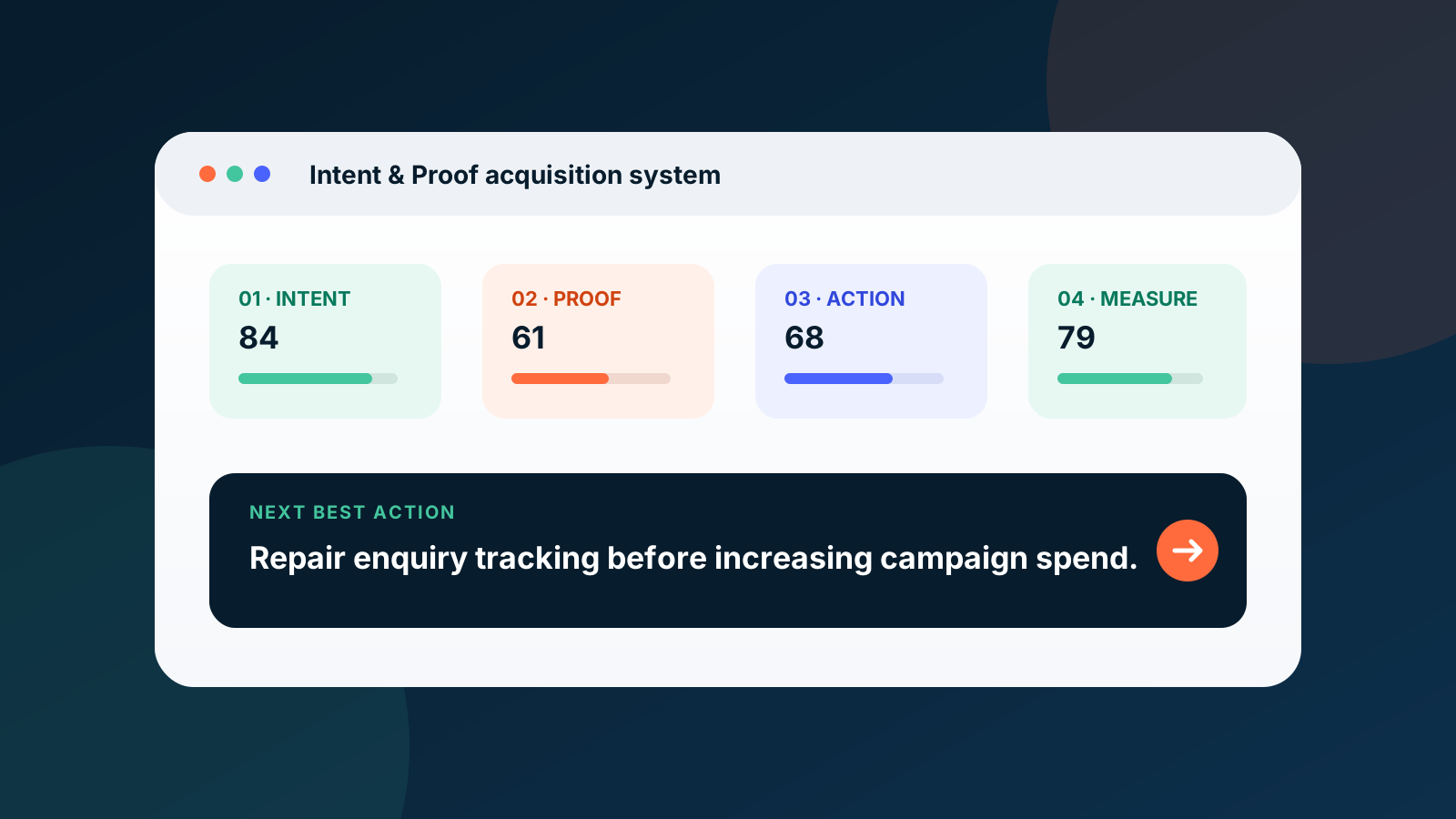
- The Intent & Proof Local Entity Distribution framework connects demand, geographic identity, distribution, destination, proof, action and measurement into one system.
A local business does not have one geographic identity online. It has many representations of the same underlying reality.
Its website describes services and locations. Google Business Profile feeds information into Google Search and Maps. Apple Business Connect can distribute location information across Apple services. Bing Places manages business information used in Bing Maps. HERE maintains another major mapping ecosystem. OpenStreetMap provides an open geographic dataset used by many applications and services.
The strategic problem is not simply whether the business appears on each platform. It is whether those systems can understand the same business, the same geography and the same commercial purpose without unnecessary ambiguity.
At Intent & Proof, we call the discipline of defining and maintaining that geographic identity Local Entity Distribution.
Definition: Local Entity Distribution is the process of defining a business’s geographic identity and representing it coherently across its website, business profiles, mapping systems and relevant geographic datasets.
This is an Intent & Proof framework, not an official Google term and not a standalone ranking factor. Its value is operational: it provides a way to connect local search visibility, geographic data, website architecture and commercial measurement into one system.
Why local search is a geographic information problem
Local search is often reduced to a checklist: optimise the Google Business Profile, collect reviews, build citations and create location pages.
Those activities can matter, but they describe pieces of a larger information problem.
A search engine trying to answer a local query needs to resolve several questions:
- What is this business?
- Where is it located or where does it operate?
- Which services does it actually provide?
- How relevant is it to the searcher’s location and intent?
- How credible and prominent is the business relative to alternatives?
Google describes its local ranking system primarily through relevance, distance and prominence. Relevance reflects how closely a Business Profile matches the search. Distance considers the relationship between the searcher and candidate businesses. Prominence reflects how well known the business is and can incorporate signals such as links and reviews. Google’s current local ranking guidance is explicit about these three dimensions.
That alone should change how local marketing is designed.
Distance is geographic by definition. Relevance depends partly on whether the system understands what the business does. Prominence is influenced by information beyond a single profile. Local visibility is therefore not cleanly divided into a website problem and a Maps problem.
The business exists as an entity across both.
A business needs a geographic model before it needs more listings
The first question is not, “Which directories are we missing?”
The first question is, “What geographic reality are we trying to represent?”
That reality changes by business model.
Fixed-location businesses communicate destinations
A dental practice, hotel, restaurant, showroom or law office normally needs people and machines to understand a physical destination.
Its geographic model can contain:
- a verified street address;
- precise coordinates;
- opening hours;
- entrance or access information;
- a primary business category;
- services available at that location;
- relationships with other locations in the same organisation.
The location is both a geographic point and a commercial destination.
Service-area businesses communicate operating territories
A mobile upholstery cleaner, plumbing company, home-care provider or yacht service has a different problem.
Customers usually do not travel to the administrative base. The business travels to customers.
The economically meaningful geography may therefore be a territory containing:
- a principal city;
- surrounding municipalities;
- neighbourhoods or districts;
- ports, marinas or commercial zones;
- different travel limits;
- different service availability by area.
For these businesses, publishing an address is not enough to explain where the company competes.
The website and external profiles need to communicate an operating geography.
This distinction matters because a business can be perfectly clear about where it is registered while remaining vague about where it actually works.
The canonical Local Entity Record
Before information is distributed externally, the business should maintain one internal reference record.
This does not need to be complicated software. A controlled spreadsheet, CMS object or database record is enough if it is treated as the source of truth.
| Layer | Fields worth controlling |
|---|---|
| Identity | Business name, trading name, brand, website, telephone |
| Classification | Primary category, secondary categories, core services |
| Geography | Address where applicable, coordinates, service areas, priority markets |
| Operations | Opening hours, availability, contact methods, service restrictions |
| Relationships | Social profiles, parent brand, branch locations, related websites |
The purpose is not obsessive uniformity.
Different platforms have different data models. A service-area business may be represented differently on Google than a fixed-location business. OpenStreetMap has mapping conventions that are not designed around marketing. An Apple place card is not structurally identical to a Google Business Profile.
The objective is semantic consistency: every system should describe the same underlying business reality even when the fields and interfaces differ.
Google Maps is part of the system, not the entire system
For many businesses, Google remains the first local-discovery priority because local results appear in both Google Search and Maps.
Google states that businesses with complete and accurate information are more likely to appear in relevant local results, while local ranking is mainly based on relevance, distance and prominence. Google Business Profile Help also notes that prominence can incorporate information such as links and reviews.
This creates a useful operating principle:
The website, Business Profile and local pages should reinforce the same entity instead of being optimised as isolated assets.
If the profile says one thing, the service pages imply another and the internal-link structure describes a third geography, the business is asking search systems to resolve contradictions that the company could have removed itself.
A strong local system makes the commercial geography explicit.
Geographic presence extends beyond Google
A business’s geographic identity can surface through several mapping ecosystems. The priority depends on the market, customer behaviour and business model.
Apple Maps and Apple Business Connect
Apple Business Connect allows businesses to add or correct location information in Apple Maps. Apple states that updates can appear across services including Maps, Siri, Safari and Calendar. Apple’s support guidance makes the wider distribution important: the place information is not confined to one map application.
For businesses serving customers who rely heavily on iPhone, CarPlay or Apple’s search interfaces, this is a meaningful discovery layer rather than a cosmetic duplicate of Google.
Bing Maps and Bing Places
Microsoft directs businesses to Bing Places for Business to add or update business information appearing in Bing Maps search results. Microsoft Support confirms that Bing Places remains the management route for those listings.
Bing is usually a lower priority than Google for many local businesses, but the cost of maintaining accurate entity information can also be relatively low once the canonical record exists.
HERE and navigation ecosystems
HERE Map Creator allows users to add or update places, addresses, roads and other map information. Its documentation specifically includes adding and updating places. HERE’s Map Creator guide provides the current workflow.
HERE becomes more strategically interesting when navigation matters: automotive, tourism, hospitality, marinas, logistics and other businesses where customers may discover or reach a location through navigation systems rather than a conventional browser search.
OpenStreetMap is infrastructure, not a citation farm
OpenStreetMap requires a different mindset.
It is an open, community-built geographic database. Its guidance for business users distinguishes factual, verifiable information such as business type, location, opening hours, website and contact details from promotional information that does not belong in the map. OpenStreetMap’s business-user guidance is explicit about that distinction.
The project has also published guidance specifically warning SEO practitioners against low-quality or promotional mapping behaviour. OpenStreetMap’s guidance for SEO mappers should be treated as a constraint, not as an obstacle to work around.
Accurate data can belong in OpenStreetMap. Marketing copy does not.
Distribution is not the same as ranking
This distinction is important enough to state plainly.
There is no official basis for claiming that creating five map listings automatically improves a Google Maps position.
Local Entity Distribution is not a citation-volume strategy.
Adding accurate representations can improve customer discovery, reduce inconsistency and make the business easier to resolve across systems. But Google’s own ranking documentation still centres relevance, distance and prominence rather than a count of external map profiles.
The useful question is therefore not:
“How many mapping platforms mention us?”
It is:
“Do the important systems represent the business accurately, and does our website convert the demand those systems help us reach?”
That moves the discussion from listing accumulation to acquisition infrastructure.
The website is part of the geographic evidence
External map profiles do not explain the full commercial territory of many businesses.
The website has to do part of that work.
For a multi-location organisation, that may mean a dedicated page for each legitimate branch.
For a service-area business, it may mean a hierarchy containing:
- a primary regional or city page;
- service pages tied to meaningful local intent;
- secondary city or district pages where demand justifies them;
- contextual internal links between geographically related pages;
- clear statements about actual coverage and limitations.
The operative phrase is where demand justifies them.
Creating 150 pages by replacing one city name with another is not a geographic strategy. It is database mail merge wearing an SEO badge.
Each local page should explain a real relationship between a service, a place and a buyer’s intent.
Use Search Console to discover the geography Google already sees
Service-area architecture should not be designed entirely from a road map.
Search Console can reveal where Google is already finding relationships between pages, services and places.
Useful questions include:
- Which local pages already receive impressions?
- Which geographic query modifiers trigger each page?
- Which locations generate impressions but few clicks?
- Are several pages appearing for the same local intent?
- Is one city page beginning to attract queries from surrounding areas?
- Are valuable service-location combinations absent even though the business serves them?
This creates a more disciplined expansion model:
Operational reality + commercial importance + observed search demand + existing visibility
That is a stronger basis for deciding which geographic pages to build or improve than simply counting nearby towns.
It also prevents a common failure mode: publishing dozens of local pages before understanding which parts of the market Google already associates with the business.
Maps can become part of the page architecture
A map on a local landing page is often treated as a checkbox.
Embed Google Map. Put it above the footer. Declare local SEO complete. Humanity survives another consultancy invoice.
A map becomes more useful when it communicates meaningful geography.
A service page for a primary city, for example, could show:
- the core city or operating area;
- nearby municipalities genuinely served;
- physical locations, if any;
- important service zones;
- clickable relationships to relevant local pages.
The map then communicates an operating territory, not merely an address.
For a fixed-location business, the message may be:
“This is where you can find us.”
For a service-area business, it may instead be:
“This is where we work.”
Those are different user questions and should lead to different map implementations.
A map is not a ranking shortcut
There is no good reason to claim that embedding a map alone produces higher local rankings.
The better case for maps is systemic:
- they can make service geography easier for customers to understand;
- they can reinforce the relationship between the page and genuinely served areas;
- they can support navigation between relevant local pages;
- they can expose gaps or overlaps in location architecture;
- they can create a clearer visual representation of an otherwise abstract service area.
The surrounding content still has to make sense without the map.
A search engine should not need to interpret an interactive widget to understand the basic geographic proposition of the page.
Internal linking should reflect commercial geography
Local pages are frequently linked according to publishing convenience rather than geographic logic.
A better architecture can reflect real relationships.
A primary city page might link to surrounding municipalities that form part of the same service market. A regional page might connect the most commercially important local hubs. A service page can link to the locations where that service has strong demand or distinctive proof.
This creates two useful effects.
First, customers can move through the site according to the geography they recognise.
Second, the site itself expresses relationships between services and places instead of leaving every page as an isolated document.
The objective is not to create the maximum number of links. It is to make the site’s geographic structure legible.
Geographic consistency should reach structured data too
Structured data should describe reality rather than repair weak content.
Where appropriate, the site’s Organization or LocalBusiness data, addresses, URLs, telephone numbers and location relationships should agree with the information visible to users.
The same principle applies to breadcrumbs, canonical URLs and location-page metadata.
Structured data is useful when it makes an already coherent entity easier for machines to parse. It is not a substitute for a coherent entity.
This distinction will become increasingly important as search systems shift from returning documents to extracting and synthesising answers from multiple sources.
From geographic presence to commercial capture
Being mapped is not the commercial outcome.
The customer still needs a useful destination and a reason to act.
The complete local acquisition chain looks more like this:
Each stage can fail independently.
A business can have excellent map visibility and send visitors to a generic homepage.
It can have strong local pages but weak profile information.
It can communicate its service territory clearly but provide no proof that the company actually performs the work there.
It can generate calls without connecting those calls back to source, page or commercial value.
A useful local system therefore measures the movement between stages rather than declaring success when one platform metric improves.
The Intent & Proof Local Entity Distribution Framework
We model geographic local acquisition across seven connected layers.
1. Demand
Question: Where is commercially valuable local demand actually appearing?
Use query data, customer data, market knowledge, seasonality and commercial priorities to identify the places and services worth competing for.
2. Geographic Entity
Question: What physical location or operating territory must search systems and customers understand?
Define the canonical business identity, address model, coordinates, service areas and relationships between locations.
3. Distribution
Question: Where should that geographic entity be represented?
Prioritise platforms according to customer behaviour and business context rather than copying the same listing everywhere indiscriminately.
4. Destination
Question: Which website experience should receive that local demand?
Map important local intent to the most relevant service, location or regional page instead of defaulting every searcher to the homepage.
5. Proof
Question: What evidence makes the local claim credible?
Use reviews, completed work, photographs, credentials, case evidence and operational detail where they actually reduce uncertainty.
6. Action
Question: What should a qualified local visitor do next?
Phone, booking, WhatsApp, form or another action should be obvious, appropriate to the service and measurable.
7. Measurement
Question: Which geographic markets produce commercially valuable outcomes?
Track local impressions and visibility, but continue through to calls, enquiries, bookings, qualified leads and revenue wherever the business can reliably connect those stages.
The framework changes the objective from “rank a listing” to “build a coherent geographic acquisition system.”
How to audit Local Entity Distribution
A practical audit can begin with five comparisons.
| Audit layer | What to compare | Typical failure |
|---|---|---|
| Identity | Website, profiles and map records | Different names, categories or phone numbers |
| Geography | Address, coordinates and service areas | Business location confused with operating territory |
| Destination | Local queries and landing pages | Important demand sent to generic pages |
| Proof | Claims and local evidence | Location pages repeat claims without local credibility |
| Measurement | Visibility, actions and commercial outcomes | Rankings reported without knowing whether enquiries improved |
The objective is not perfect data symmetry.
It is to identify contradictions large enough to affect discovery, trust or conversion.
What should be prioritised first?
Not every business needs to optimise every map platform on day one.
A useful sequence is:
- Define the canonical entity and operating geography.
- Fix the website and primary local-search presence.
- Connect important demand to useful local destinations.
- Expand distribution where the customer journey justifies it.
- Measure geographic visibility against enquiries and commercial value.
For many businesses, Google Business Profile and the website will remain the highest-priority combination.
Apple can become important when iPhone and Apple navigation usage is commercially meaningful. HERE deserves more attention where automotive navigation and destination discovery matter. Bing may justify inclusion because maintaining accurate information is relatively inexpensive once the entity record exists. OpenStreetMap should be edited only where factual map data legitimately belongs.
Prioritisation is part of the strategy. Being everywhere badly is not a mature distribution model.
Local Entity Distribution and the future of search
The importance of entity clarity is likely to increase as search interfaces change.
Traditional search ranking asks which documents or local results should be shown.
Answer engines and AI-assisted search introduce another problem: which sources, entities and facts can be retrieved, reconciled and trusted strongly enough to support a generated answer?
That does not make conventional SEO obsolete. It makes machine-readable clarity, consistent entities and retrievable evidence more important.
A local business that accurately defines what it is, where it operates and which pages support those claims is building assets that can serve both conventional search and emerging answer systems.
This is one reason Local Entity Distribution should be treated as infrastructure rather than a temporary local SEO tactic.
The operating principle
A local business should not aim to accumulate the maximum possible number of map listings.
It should aim to become geographically understandable wherever relevant demand is interpreted.
That means:
- a clear canonical identity;
- an accurate physical or service-area model;
- controlled distribution across relevant map systems;
- useful local destinations on the website;
- proof connected to geographic claims;
- action paths matched to buyer intent;
- measurement that reaches beyond rankings.
When those elements reinforce one another, local search stops being a collection of disconnected SEO tasks.
It becomes market infrastructure.
Frequently asked questions
What is Local Entity Distribution?
Local Entity Distribution is the Intent & Proof framework for defining a business's geographic identity and representing it consistently across its website, business profiles, mapping platforms and relevant geographic datasets. It is not an official Google term or a standalone ranking factor. The purpose is to reduce ambiguity about what the business is, where it is located or operates, which services it provides and which local demand its website is designed to capture.
Does being listed on more maps improve Google rankings?
Not automatically. Google says local results are mainly based on relevance, distance and prominence. Creating additional accurate geographic representations can improve overall entity consistency and customer discovery, but there is no official evidence that simply adding a business to Apple Maps, Bing Maps, HERE or OpenStreetMap directly raises its Google Maps position. Distribution should be treated as infrastructure, not as a citation-counting trick.
Does adding a Google Map to a local landing page improve SEO?
An embedded map is not a proven ranking shortcut by itself. Its value is stronger when it helps users understand a real location or service area and when the surrounding page consistently describes the same geography through useful content, internal links, structured data and business information. A map should communicate something operational rather than exist as decorative local SEO furniture.
What is the difference between a location business and a service-area business?
A location business needs customers and search systems to understand a physical destination, such as a clinic, restaurant or office. A service-area business travels to customers and therefore needs to communicate where it operates rather than simply where its administrative base is located. That difference should influence business-profile settings, location architecture, local pages, map design and the language used across the site.
Which map platforms should a local business manage?
Google Business Profile and Google Maps are usually the first priority because of their role in local search. Apple Business Connect is important for Apple Maps and other Apple surfaces, while Bing Places can manage business information in Bing Maps. HERE can matter for navigation and automotive contexts. OpenStreetMap is useful as an open geographic dataset but should be edited according to its mapping rules, not treated as a promotional directory.
How should a service-area business show the areas it serves on its website?
Start with operational reality and search evidence. Define the primary market, important surrounding cities or districts, and any service constraints. Then connect those places to useful service or location pages where justified by demand. A map can visualise the territory, while internal links, copy and structured data should make the same geographic relationships understandable without relying on the map alone.
Can Search Console help design local service-area pages?
Yes. Search Console can reveal which local pages already receive impressions, which geographic queries trigger them, where click-through is weak and whether several pages appear to compete for similar intent. Those signals can be combined with commercial importance and operational coverage to decide where new pages, stronger internal links or clearer geographic explanations are justified.
What should a local entity record contain?
A practical local entity record should contain the business name, brand, website, telephone, primary category, physical address where applicable, coordinates, service areas, important locations, core services, opening hours and relevant profile relationships. This internal record becomes the reference used to check whether external platforms are describing the same underlying business accurately.
Is OpenStreetMap a business directory for local SEO?
No. OpenStreetMap is a community-built geographic database, not a promotional business directory. Its own guidance stresses that business information should be factual, verifiable and appropriate to the map. Accurate business data may belong there, but promotional language, artificial edits and mass citation-building behaviour do not.
How do you measure whether geographic local SEO is working?
Measure the chain rather than one ranking. Useful signals include local impressions, Maps and search visibility, geographic query coverage, clicks to relevant location pages, calls, enquiries, bookings and qualified commercial outcomes. For businesses operating across several areas, geographic rank grids and Search Console page-query data can help show where visibility is expanding or weakening.