Summary
Key takeaways
- Most specialist firms do not lack experience; they lack a structured way to make that experience visible, credible and commercially useful.
- A case study is strongest when it reduces buyer risk by showing context, constraints, judgement, execution and proportionate evidence.
- Proof should appear throughout the buying journey, not remain isolated on a testimonials or portfolio page.
- A repeatable evidence-capture system turns completed client work into a durable commercial asset.
A specialist firm can spend years building real expertise and still look almost interchangeable with weaker competitors online.
The website describes experience. The proposal lists services. The portfolio shows polished output. A few testimonials say the team was professional and reliable. Yet none of this necessarily helps a cautious buyer answer the question that matters most:
Can this firm solve a problem like ours, under conditions like ours, without creating unacceptable risk?
That question becomes more important as the service becomes more expensive, complex or consequential. A buyer selecting an engineering consultant, financial adviser, technology partner, specialist contractor or premium service provider cannot inspect the final result before committing. The buyer is purchasing an expected outcome delivered through an uncertain future process.
The commercial problem is therefore not simply a lack of visibility. It is a lack of usable proof.
Many firms possess substantial evidence of competence, but that evidence remains scattered across client emails, reports, photographs, internal dashboards, repeat assignments, referrals and the founder’s memory. The firm knows that the work was difficult. The client knows that it was valuable. The next buyer sees only the final claim.
This gap between actual competence and perceived competence has a direct economic cost. It increases price sensitivity, lengthens sales cycles, weakens proposal acceptance and forces senior people to rebuild trust from zero during every important conversation. A competitor with less experience but clearer evidence can appear safer, because buyers rarely choose the provider with the greatest hidden capability. They choose the provider whose capability they can understand and defend.
The operating principle: a case study is not a success story. It is a structured risk-reduction asset.
Why specialist firms struggle to demonstrate value
Professional and technical services are difficult to evaluate before purchase. The buyer can usually see the promised deliverable, but not the judgement, coordination and risk control required to produce it. This is why specialist firms often describe themselves through broad claims such as expertise, quality, innovation and personal attention. The claims may be true, but they are too general to resolve a specific decision.
The weakness becomes obvious when the commercial journey is viewed as a sequence rather than a collection of pages.
Most firms move directly from real capability to a marketing claim. The missing stages are the reason years of work fail to accumulate into a durable acquisition advantage.
A strong proof system does not attempt to tell every story. It identifies the decisions the target buyer must make, the risks attached to those decisions and the evidence capable of reducing each risk. The result is more useful than a general display of competence because it gives the buyer material that can be evaluated, compared and shared internally.
Why B2B buyers need more than confident language
Complex purchases rarely depend on one person making an isolated choice. A service may be discovered by a marketing manager, evaluated by an operational team, reviewed by finance and approved by a director who has never spoken with the provider. Each participant sees a different risk.
The first contact may be convinced by expertise. Finance may need cost control. Operations may care about disruption. Senior management may need assurance that the decision can be defended if the engagement fails.
This means proof must do more than attract attention. It must help the original contact explain the provider to people who were not present during the sales conversation. Gartner’s research on the B2B buying journey describes a nonlinear process in which buyers revisit problem identification, solution exploration, requirements, supplier selection, validation and consensus creation. Useful content must therefore support several decisions, not merely generate a first click.
A useful case study can travel through this process. It gives the buyer a recognisable situation, a clear account of the work, evidence of the result and language that can be repeated internally. A weak case study merely celebrates the company that published it.
The trust problem is not theoretical. Forrester’s research on trusted B2B information sources found that buyers place particularly high trust in colleagues, internal management and providers with whom they already have an established relationship. A new supplier must therefore provide evidence strong enough to travel beyond the first contact and survive internal scrutiny.
Portfolio, testimonial and case study are different assets
A portfolio, a client logo, a testimonial and a case study can all support trust, but they do not perform the same function.
A client logo shows association. It does not explain what the firm did. A portfolio item reveals an output, but often removes the commercial context and the constraints. A testimonial records satisfaction, yet may be too generic to help another buyer assess relevance. Performance data can demonstrate change, but becomes misleading when the baseline and conditions are missing.
A case study connects these fragments into an intelligible account of applied capability.
| Asset | What it can demonstrate | Main limitation |
|---|---|---|
| Client logo | Association with a known organisation | Does not explain the work performed |
| Portfolio item | Visible output or completed deliverable | Often omits context and decision-making |
| Testimonial | Client confidence or satisfaction | Frequently generic and difficult to compare |
| Performance data | A measurable change | Can mislead without a baseline and conditions |
| Case study | Capability applied to a defined situation | Requires disciplined evidence collection |
A commercially useful case should allow the reader to understand who the client or client type was, what outcome mattered, what made the work difficult, how the provider diagnosed the problem, what decisions were made and what evidence supports the result. It should also explain why the experience is relevant to the reader.
Without that structure, the content may still be accurate. It is simply difficult to use as decision evidence.
Why generic testimonials do not reduce enough risk
“Excellent service”, “professional and reliable” and “we would highly recommend the team” are sincere statements that could appear beneath almost any business logo. They create reassurance, but very little diagnostic information.
A buyer cannot tell what was delivered, what level of complexity was involved, whether deadlines were met, how communication worked or whether the experience resembles the situation now being considered.
A stronger testimonial is not necessarily more enthusiastic. It is more specific. It might explain that the provider entered an active operating environment, adapted the work around a fixed completion window and delivered without interrupting customer-facing areas. That statement reduces uncertainty because it describes a capability under conditions.
The principle is simple: proof should correspond to the buyer’s concern. A finance director, an operations manager and a technical lead do not carry the same risk, even when they are evaluating the same provider.
The buyer-risk model
High-value service purchases usually contain several forms of perceived risk. Competence risk asks whether the provider can perform the work. Execution risk asks whether the work can be delivered reliably. Commercial risk concerns scope, cost and expectations. Operational risk concerns disruption. Reputational risk concerns visible failure. Decision risk concerns whether the buyer can justify the selection internally.
These risks require different evidence.
| Buyer risk | The question behind it | Useful proof |
|---|---|---|
| Competence | Can they do the work? | Comparable assignments, technical method, specialist experience |
| Execution | Can they deliver under real conditions? | Milestones, sequencing, communication and contingency handling |
| Commercial | Will scope and cost remain controlled? | Pricing logic, exclusions, change control and budget evidence |
| Operational | Will the engagement disrupt the organisation? | Continuity planning, phased delivery and coordination records |
| Reputational | Could this decision create visible failure? | Quality controls, discretion, compliance and references |
| Decision | Can I defend this choice internally? | Clear business case, relevant outcomes and transparent methodology |
The strongest case studies address several of these risks naturally. They do not read like defensive legal documents. They simply contain enough reality to show how the provider behaves when conditions are not ideal.
Why most B2B case studies are unconvincing
Weak case studies tend to fail in predictable ways. The client is described as “a leading company”, which removes every detail a comparable buyer might recognise. The problem is sanitised until no difficulty remains. The intervention becomes a list of services rather than an explanation of judgement. The results appear without a baseline. The story proceeds perfectly, with no trade-offs, adaptations or uncertainty.
The result is polished but strangely weightless.
A credible case does not need to embarrass the client or expose confidential information. It needs to preserve the features that made the engagement meaningful. A family-owned industrial business operating across three sites is more useful than “a leading company”. A project delivered without replacing a legacy system is more informative than “we implemented a new solution”. A conversion increase measured over a defined period is more credible than an isolated percentage.
Real projects contain constraints. They also contain decisions. Removing both eliminates the very elements that demonstrate expertise.
The Intent & Proof case-study framework
Intent & Proof uses five connected components to turn completed work into commercially useful evidence.
The framework is deliberately sequential. Context makes the situation recognisable. Constraint reveals what made it difficult. Intervention demonstrates judgement. Evidence supports the conclusion. Relevance connects the experience to the next buyer.
Context: make the situation recognisable
Context allows a reader to determine whether the case resembles the problem they are facing. It should establish the type of organisation, sector, scale, operating environment, starting condition and commercial objective.
“A client wanted to improve its marketing” provides almost no useful signal. A specialist regional service company that relied on referrals and paid search but could not identify which enquiries became profitable work is immediately more recognisable.
The client does not always need to be named. What matters is preserving the characteristics that influence the problem and the solution.
Good context also explains why the issue mattered. A fragmented measurement system is not merely untidy. It may cause management to increase spend in channels that generate low-value enquiries. A weak proposal process is not merely inconvenient. It may force a technically strong firm to compete on price because the buyer cannot see the difference.
Constraint: reveal what made the work difficult
Constraint is one of the most neglected elements of commercial proof. It explains why the result required more than routine execution.
The constraint may be a fixed deadline, incomplete data, a live operational environment, several decision-makers, legacy technology, regulation, confidentiality or the need to preserve existing search visibility during a website migration.
Without constraint, the reader cannot evaluate judgement. A website redesign in an unrestricted environment is different from one completed without losing rankings, interrupting campaigns or preventing non-technical staff from publishing. A technical service performed in an empty facility is different from one delivered inside an active medical, industrial or luxury environment.
Constraint turns an output into evidence of capability.
Intervention: explain decisions rather than activities
A case becomes persuasive when it reveals how the provider thought.
“We created new landing pages and improved tracking” describes purchased activities. It does not explain why they were chosen or in what order.
A stronger account might show that an audit identified the largest measurable loss after visitors reached generic service pages. Instead of increasing traffic immediately, the firm rebuilt one priority path first, aligning the query, page, proof, action and measurement. Expansion was delayed until the corrected path produced reliable information.
The difference is not stylistic. The second account demonstrates diagnosis, prioritisation and controlled judgement.
Intervention should therefore explain what was prioritised, what was postponed, which alternative was rejected and how the plan changed when new evidence appeared. Buyers of specialist services are often evaluating the quality of decisions as much as the quality of output.
Evidence: support the claim proportionately
Evidence should match the strength of the conclusion. It may include before-and-after metrics, photographs, project records, costs avoided, time saved, revenue generated, repeat assignments, referrals or specific client testimony.
The important discipline is separating observation from interpretation.
Suppose qualified enquiries increased from 18 to 27 during the comparison period. The observed fact is the change in enquiries. The calculation is a 50 percent increase. The interpretation may be that stronger intent alignment and a simpler enquiry path contributed to the improvement. The limitation may be that seasonality and campaign changes prevent attribution to one website change alone.
This distinction does not weaken the result. It prevents the case from claiming more than the evidence can support.
A modest result that survives scrutiny is more valuable than an impressive number that collapses after one sensible question.
Google’s own guidance on creating helpful, reliable, people-first content asks whether a page contains original information, substantial analysis, clear sourcing and demonstrable first-hand expertise. Detailed case studies can satisfy those qualities particularly well when their evidence and limitations remain explicit.
Relevance: connect the case to the next buyer
A case study should not end with the provider congratulating itself. It should explain where the experience applies, which organisations are likely to benefit and which conditions are required for success.
A measurement project, for example, may be most relevant to firms already generating sufficient demand but unable to connect enquiries with commercial quality. It may be less useful to a business that has not yet established a viable offer or enough activity to measure.
This final step turns the case from a historical account into a decision tool. It also improves qualification. A reader who recognises the conditions can move forward with greater confidence. A reader who does not fit can rule the solution out before consuming sales time.
How to publish a case when the client must remain confidential
Confidentiality is common in consulting, finance, healthcare, legal services, technology, luxury markets and specialist contracting. It should change the presentation of evidence, not eliminate evidence entirely.
A client can be anonymised through relevant descriptors such as sector, approximate size, geography, operating model and type of challenge. Exact figures can be replaced with percentages, ranges or indexed values. The public version can explain the context, method and non-sensitive result, while stronger validation remains available privately during a qualified sales process.
Permission can also be obtained by component. A client may approve the sector but not the company name, a result but not the baseline, a quotation without an employee identity or photographs without location details. Treating approval as a single all-or-nothing request often destroys useful proof unnecessarily, another small triumph of administrative convenience over commercial intelligence.
Evidence should be collected during delivery
The worst time to reconstruct a case study is six months after completion. By then baseline information has disappeared, screenshots have changed, team members have moved on and useful decisions were never recorded.
Evidence capture should begin with the engagement.
At the start, record the initial condition, commercial objective, baseline, scope and relevant risks. During delivery, retain important decisions, constraints, milestone evidence and changes to the plan. At completion, document the outcome, client feedback, limitations, follow-on work and publication permissions.
This does not require a heavy administrative system. A structured form or project record is sufficient. The value comes from consistency.
A short client interview can strengthen the record. Instead of asking for a general testimonial, ask what was happening before the engagement, why the issue mattered, which concerns existed, what part of the process was valuable and what changed afterward. These questions produce evidence rather than ceremonial praise.
Build an evidence inventory before writing
Most established firms already possess more proof than they realise. The problem is usually organisational.
An evidence inventory can include client feedback, performance data, project reports, photographs, process documents, repeat assignments, referrals, qualifications and market recognition. Each item should then be assessed for relevance, credibility, sensitivity, freshness, verification and permission.
This inventory often reveals that the business does not need to manufacture new authority. It needs to organise the authority it has already earned.
Proof must be distributed across the buying journey
Publishing a full case study is useful, but it is not the final objective. Evidence should appear where uncertainty arises.
At the discovery stage, a short case excerpt can show that the firm understands a recognisable problem. During evaluation, the buyer may need the full account, process detail and outcome. During internal justification, the initial contact may need a concise summary that can be forwarded to colleagues. Inside a proposal, one closely matched case may answer a specific objection more effectively than five unrelated success stories.
The same flagship case can therefore produce several assets: a complete website article, a service-page proof block, a proposal excerpt, a one-page PDF, an email follow-up and a concise internal decision summary. The language and length should change according to the decision point, while the underlying evidence remains consistent.
Proof architecture in AI-assisted buying
Buyers increasingly use AI systems to summarise providers, compare approaches and identify possible suppliers. This increases the value of structured, explicit evidence.
A page filled with slogans and generic praise is difficult for both a human and a machine to interpret. A case containing a defined client type, problem, constraint, intervention, result and limitation is easier to understand, compare and cite.
AI-readable proof should therefore be specific, attributed where possible, internally consistent and clear about the limits of the claim. This does not mean writing for machines instead of people. It means removing ambiguity from evidence.
The firms most likely to benefit are those with genuine expertise that has historically remained trapped inside unstructured documents and private conversations.
How to measure proof architecture
Case-study page views reveal very little by themselves. The useful question is whether exposure to proof changes meaningful behaviour.
A practical measurement chain is:
Track which cases are viewed before contact, whether visitors move from the case to a relevant service, which leads mention a specific example and which cases are used during proposals. Over time, compare proposal acceptance, sales-cycle duration, average engagement value and the number of reassurance requests required before a decision.
Attribution will never be perfect. A consistent directional model is still more useful than treating case studies as decorative content and hoping the sales team somehow absorbs their value through proximity.
| Stage | Useful metric | Commercial question |
|---|---|---|
| Exposure | Relevant case-study views | Are suitable buyers encountering the evidence? |
| Engagement | Read depth and return visits | Are buyers investigating the proof? |
| Progression | Movement to service or contact pages | Does the evidence support a next step? |
| Sales use | Cases used in proposals and follow-up | Is the asset helping real opportunities? |
| Conversion | Proposal acceptance and close rate | Does matched proof support selection? |
| Efficiency | Sales-cycle length and reassurance required | Does evidence reduce friction? |
| Value | Average engagement value and margin | Does proof contribute to better business? |
A 30-day proof-building plan
The first month should produce one strong, reusable case and a repeatable evidence process. It should not produce a ceremonial content calendar containing twelve weak stories.
During the first five days, audit existing testimonials, reports, project records, results and photographs. Then select a flagship case based on strategic relevance, buyer recognition, evidence quality, differentiation and permission. The strongest choice is not automatically the largest client or most visually impressive project.
The middle of the month should be used to verify the context, interview participants and draft the case through the five-part framework. The final stage is distribution: place a concise version on the relevant service page, prepare an excerpt for proposals and configure basic measurement.
| Period | Work | Deliverable |
|---|---|---|
| Days 1–5 | Audit existing evidence | Evidence inventory |
| Days 6–10 | Select the highest-value case | Flagship-case brief |
| Days 11–17 | Verify context, decisions and results | Complete case record |
| Days 18–23 | Write and review the case | Approved long-form case |
| Days 24–27 | Create service, proposal and short versions | Proof distribution pack |
| Days 28–30 | Configure measurement and future capture | Proof dashboard and process |
One detailed and properly distributed case can create more commercial value than a library of vague client summaries.
Build a proof system, not a one-time content project
A firm should not need to launch a new investigation every time it wants to publish a case. The process should become part of delivery.
For each suitable engagement, record the initial situation, establish the baseline, identify the objective, document constraints, retain important decisions, collect evidence, request feedback and confirm permissions. This creates institutional memory and improves the firm’s ability to understand which parts of its method generate value.
Proof architecture therefore contributes to more than marketing. It strengthens organisational learning.
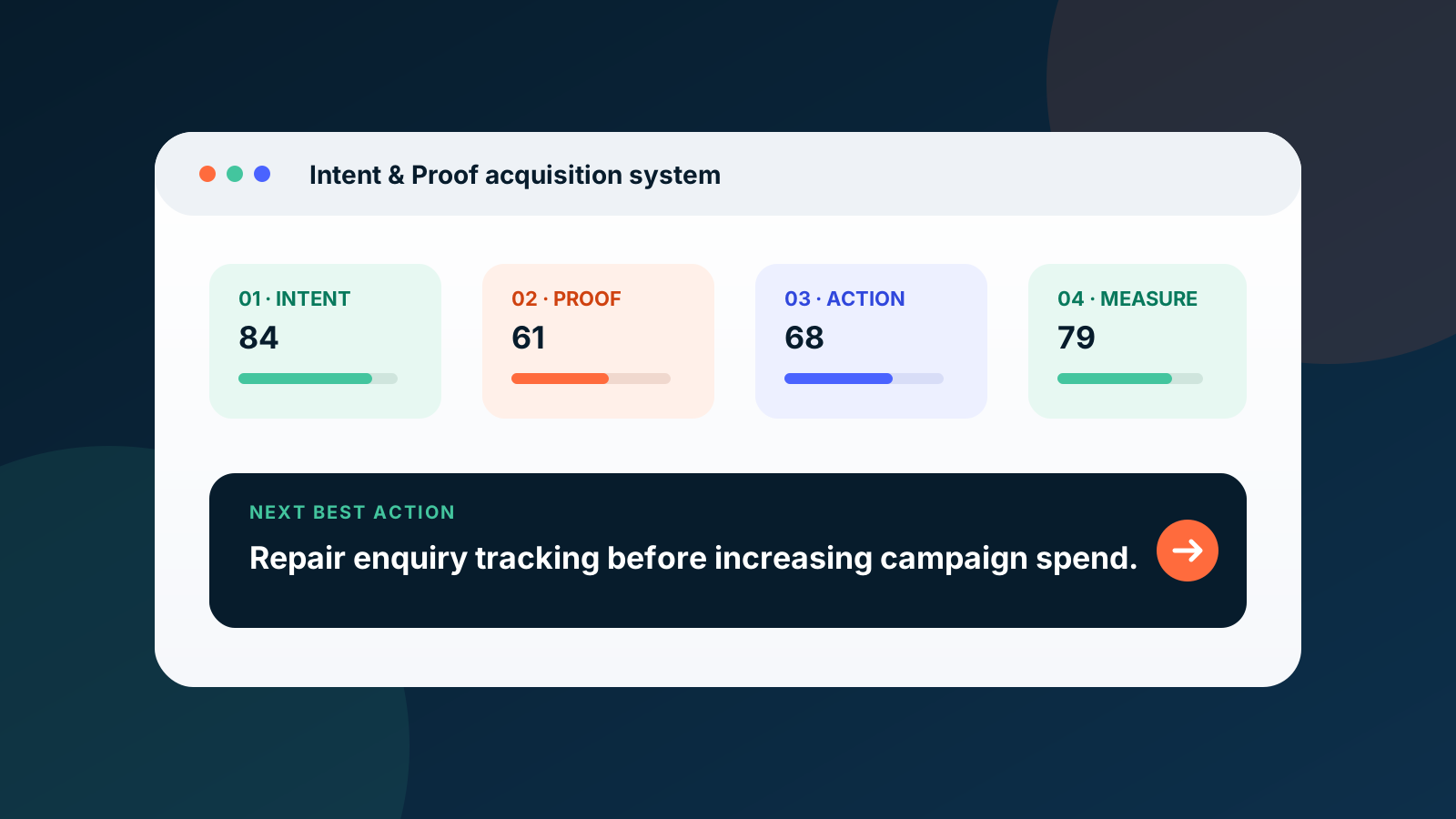
The Intent & Proof operating system
Intent & Proof treats high-value acquisition as four connected disciplines.
Intent alignment identifies the buyer, problem and commercial situation the proof must support. A case written for everybody usually feels relevant to nobody.
Proof architecture organises evidence around buyer decisions. This may include firm-level credibility, expert qualifications, service methodology, client validation, operational reliability and measurable outcomes.
Action design connects proof to an appropriate next step. A buyer may need to inspect a related service, request an assessment, submit a project brief or ask for a private reference. The action should continue the decision rather than interrupt it with a generic contact demand.
Measurement integrity connects proof exposure to service evaluation, qualified enquiries, proposals, decisions and value. The purpose is not to create another dashboard. It is to determine whether better evidence changes commercial behaviour.
The same operating logic appears in our guide to turning local searches into real medical appointments, where visibility is treated as only the first stage of a system connecting intent, proof, action and measurable value.
Final principle: do not claim more
When a specialist firm struggles to win higher-value clients, the immediate response is often to increase activity. Publish more content. Run more advertising. Redesign the website. Add more testimonials. Use stronger adjectives.
These actions can increase exposure while leaving the trust problem untouched.
The buyer may still be unable to determine whether the provider understands the situation, whether the work involved genuine complexity, how decisions are made, whether the claimed result is credible or whether the experience applies to the current problem.
The stronger approach is to make existing capability easier to verify.
A proof system identifies the decisions that require evidence, inventories the material already available, documents context and constraints, demonstrates judgement, supports outcomes proportionately and places the resulting evidence where the buyer needs it.
That is how completed client work becomes a durable commercial asset.
The firm does not need to sound more confident.
It needs to become easier to believe.
Sources, further reading and methodology
This guide combines the Intent & Proof acquisition framework with current first-party research and guidance concerning B2B buying, trust and content quality.
Google Search Central’s people-first content guidance recommends original information, substantial analysis, clear sourcing and demonstrable first-hand expertise. Detailed cases based on real work fit this standard when claims and limitations remain explicit.
Gartner’s B2B buying journey research describes a nonlinear process involving problem identification, solution exploration, requirements building, supplier selection, validation and consensus creation. This supports the need for evidence that helps several stakeholders complete different buying tasks.
Forrester’s research on trusted B2B information sources shows the importance buyers place on colleagues, internal management, existing providers and credible expert validation. Its analysis of risk and defensive B2B decisions further explains why competence, consistency and dependability matter when buyers evaluate an unfamiliar supplier.
For a practical application of the broader Intent → Proof → Action → Measurement model, read How Medical Practices Can Turn Local Searches Into Real Appointments Without Discounting Their Brand.
The search-demand research behind this article covers the semantic cluster around B2B case study strategy, professional-services case studies, demonstrating expertise online, building trust in B2B sales, anonymous client cases and social proof for specialist firms. These concepts are used when they clarify the buyer’s problem and the operating method, rather than being repeated as decorative keywords.
Frequently asked questions
What makes a good B2B case study?
A strong B2B case study explains the client context, the commercial objective, the constraints, the provider's decisions, the work performed and the evidence supporting the result. It should help a similar buyer judge whether the provider has solved a comparable problem under realistic conditions.
How is a case study different from a testimonial?
A testimonial records a client's opinion or experience. A case study provides a structured account of the situation, intervention and result. A testimonial can strengthen a case study, but generic praise does not replace evidence about what was done, why it was difficult and what changed.
Can a case study be published without naming the client?
Yes. The client can be anonymised using relevant descriptors such as sector, approximate size, geography, operating model and project type. Sensitive figures can be expressed through percentages, ranges or indexed values, while stronger validation can remain available privately during a qualified sales process.
How many case studies should a specialist firm publish?
There is no universal number. A useful starting point is one strong case for each priority buyer, service or risk profile. Several closely matched and evidence-rich cases are usually more useful than a large collection of shallow project summaries.
Do case studies help with SEO?
Case studies can support search visibility because they contain original experience, specific entities, useful detail and first-hand evidence. Their primary commercial role, however, is to help relevant buyers evaluate the provider and move toward a decision.
What is proof architecture?
Proof architecture is the organised collection, verification, positioning and measurement of evidence across the buying journey. It connects case studies, testimonials, performance data, process evidence, qualifications, references and operational proof to the buyer risks each item is intended to reduce.